Ch. 13 - Alcohols, Ethers and Related Compounds: Substitution and Elimination
Mullins - Organic Chemistry: A Learner Centered Approach 1st Edition
Mullins1st EditionOrganic Chemistry: A Learner Centered ApproachISBN: 9780137566471당신이 사용하는 게 아니라요?교과서 변경
12장, 문제 38

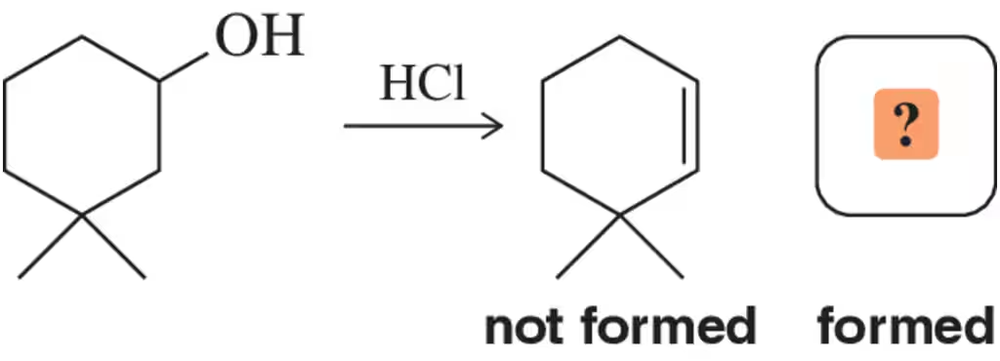
When HCl was used for the attempted dehydration reaction shown, a reaction occurred, but none of the desired product was formed. Suggest the identity of the actual product obtained.
Chemical reaction diagram showing dehydration with HCl; product not formed indicated with a question mark.

검증된 단계별 안내
1
Step 1: Begin by analyzing the dehydration reaction. Dehydration reactions typically involve the removal of a water molecule from an alcohol to form an alkene. In this case, HCl is used as the acid catalyst, which can protonate the alcohol group.
Step 2: Consider the mechanism of the reaction. When HCl is added, the hydroxyl group (-OH) of the alcohol is protonated to form a good leaving group, water (H₂O). This step is crucial for the formation of a carbocation intermediate.
Step 3: Evaluate the stability of the carbocation intermediate formed after the departure of water. Carbocation stability is influenced by factors such as hyperconjugation and resonance. If the carbocation can rearrange to a more stable form, it will do so.
Step 4: Recognize that HCl introduces chloride ions (Cl⁻) into the reaction mixture. These chloride ions can act as nucleophiles and attack the carbocation, leading to the formation of a substitution product (an alkyl chloride) instead of the desired alkene.
Step 5: Conclude that the actual product obtained is likely an alkyl chloride, formed via nucleophilic attack by Cl⁻ on the carbocation intermediate. This substitution reaction competes with the intended elimination reaction, preventing the formation of the desired alkene.

비슷한 문제에 대한 검증된 영상 답변:

이 영상 해법은 위 문제에 도움이 된다고 튜터들이 추천한 것입니다.
영상 길이:
1m

주요 개념

질문에 올바르게 답하기 위해 반드시 이해해야 하는 핵심 개념들은 다음과 같습니다.

Dehydration Reactions

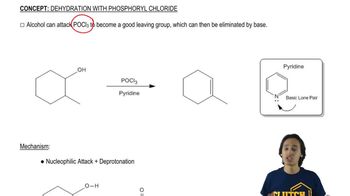
Dehydration reactions involve the removal of a water molecule from a compound, typically resulting in the formation of a double bond or a cyclic structure. In organic chemistry, these reactions are crucial for synthesizing alkenes from alcohols. Understanding the mechanism and conditions under which dehydration occurs is essential for predicting the products formed.
추천 영상:
01:23
General Reaction of Dehydration with POCl3

Acid-Catalyzed Reactions

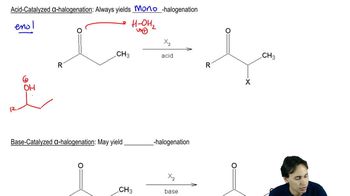
Acid-catalyzed reactions utilize acids, such as HCl, to facilitate the transformation of reactants into products. In dehydration reactions, the acid protonates the alcohol, making it a better leaving group. This concept is vital for understanding how the presence of an acid can influence the reaction pathway and the products formed, including potential side reactions.
추천 영상:
03:09
Acid Catalyzed

Carbocation Stability

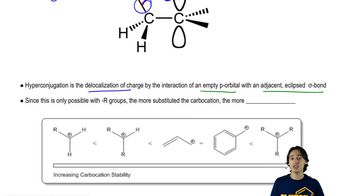
Carbocation stability is a key factor in determining the outcome of many organic reactions, including dehydration. Carbocations are positively charged carbon species that can rearrange or react further based on their stability, which is influenced by factors such as alkyl substitution and resonance. Recognizing the stability of potential carbocations helps predict the actual products formed in reactions, especially when the desired product is not obtained.
추천 영상:
05:58
Determining Carbocation Stability