There were actually two possible products in the solvolysis reaction from Figure 21.10. Show both products. Which would you expect to be more stable? Why?
Ch. 21 - Conjugated Systems 1: Stability and Addition Reactions

Mullins1st EditionOrganic Chemistry: A Learner Centered ApproachISBN: 9780137566471당신이 사용하는 게 아니라요?교과서 변경
20장, 문제 14
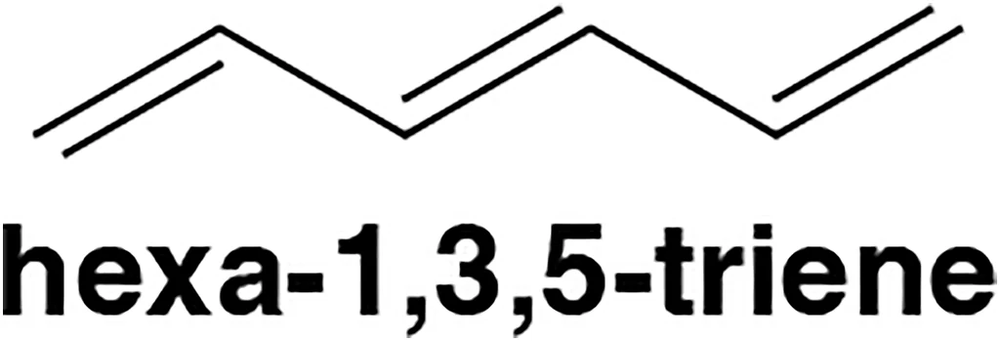
Hexa-1,3,5-triene uses six p orbitals, each containing a single electron, to make its three π bonds. How many total molecular orbitals are made by the six p orbitals?

검증된 단계별 안내1
Step 1: Recall the principle of molecular orbital theory, which states that when atomic orbitals combine, they form the same number of molecular orbitals as the number of atomic orbitals involved.
Step 2: Identify the number of atomic orbitals involved in the system. In this case, there are six p orbitals (one from each carbon atom in the conjugated system of hexa-1,3,5-triene).
Step 3: Understand that these six p orbitals will combine to form six molecular orbitals. These molecular orbitals will include bonding, non-bonding, and anti-bonding orbitals.
Step 4: Recognize that the molecular orbitals will be arranged in increasing energy levels, with the lowest energy orbitals being bonding, the highest energy orbitals being anti-bonding, and any intermediate orbitals being non-bonding (if applicable).
Step 5: Conclude that the total number of molecular orbitals formed is equal to the number of atomic orbitals involved, which is six in this case.

비슷한 문제에 대한 검증된 영상 답변:
이 영상 해법은 위 문제에 도움이 된다고 튜터들이 추천한 것입니다.
영상 길이:
2m도움이 되었나요?
주요 개념
질문에 올바르게 답하기 위해 반드시 이해해야 하는 핵심 개념들은 다음과 같습니다.
Molecular Orbitals
Molecular orbitals (MOs) are formed when atomic orbitals combine during the bonding process. In the case of hexa-1,3,5-triene, the six p orbitals from the carbon atoms interact to create new orbitals that can be occupied by electrons. The number of molecular orbitals generated is equal to the number of atomic orbitals that combine.
추천 영상:
Review of Molecular Orbitals
π Bonds
π bonds are a type of covalent bond formed by the sideways overlap of p orbitals. In hexa-1,3,5-triene, three π bonds are created from the interaction of the six p orbitals, allowing for the delocalization of electrons across the molecule. This delocalization contributes to the stability and reactivity of the compound.
추천 영상:
Single bonds, double bonds, and triple bonds.
Orbital Count
The total number of molecular orbitals formed is directly related to the number of atomic orbitals involved in the bonding. For hexa-1,3,5-triene, with six p orbitals participating, the total number of molecular orbitals created is also six. This principle is fundamental in understanding how electrons are distributed in a molecule.
추천 영상:
Electron Counting
관련 실천
교과서 질문
1241
views
교과서 질문
The molecular orbital picture of H2 can be represented by the following diagram. Label σ and σ* on the diagram—that is, which is (a) and which is (b)? Which is lower in energy? Why?
<IMAGE>
1326
views
교과서 질문
p-Nitrophenol (pKa = 7.2) is ten times more acidic than m-nitrophenol (pKa = 8.4) Explain.
2576
views
교과서 질문
Suppose a molecule is formed by the overlap of 16 atomic orbitals.
(a) How many molecular orbitals will be present?
(b) How many will be bonding?
(c) How many will be antibonding?
1378
views
교과서 질문
The ψ2 molecular orbital for octa-1,3,5,7-tetraene is shown. Draw ψ3.
<IMAGE>
1702
views
교과서 질문
Why is this not a viable representation of the ψ2, molecular orbital of buta-1,3-diene?
1104
views