Ch. 21 - Conjugated Systems 1: Stability and Addition Reactions
Mullins - Organic Chemistry: A Learner Centered Approach 1st Edition
Mullins1st EditionOrganic Chemistry: A Learner Centered ApproachISBN: 9780137566471당신이 사용하는 게 아니라요?교과서 변경
20장, 문제 12

Suppose a molecule is formed by the overlap of 16 atomic ­orbitals.
(a) How many molecular orbitals will be present?
(b) How many will be bonding?
(c) How many will be antibonding?

검증된 단계별 안내
1
Step 1: Recall the principle of molecular orbital theory, which states that when atomic orbitals combine, they form an equal number of molecular orbitals. If 16 atomic orbitals overlap, there will be 16 molecular orbitals formed.
Step 2: Understand that molecular orbitals are classified as bonding, antibonding, or non-bonding. Bonding orbitals are lower in energy, while antibonding orbitals are higher in energy. Non-bonding orbitals, if present, remain at the same energy level as the atomic orbitals.
Step 3: For a simple system with no non-bonding orbitals, the molecular orbitals are evenly split into bonding and antibonding orbitals. Therefore, half of the molecular orbitals will be bonding, and the other half will be antibonding.
Step 4: Calculate the number of bonding orbitals by dividing the total number of molecular orbitals by 2. For 16 molecular orbitals, the number of bonding orbitals is 16 ÷ 2 = 8.
Step 5: Similarly, calculate the number of antibonding orbitals, which is also 16 ÷ 2 = 8. Thus, there are 8 bonding orbitals and 8 antibonding orbitals in this system.

비슷한 문제에 대한 검증된 영상 답변:

이 영상 해법은 위 문제에 도움이 된다고 튜터들이 추천한 것입니다.
영상 길이:
2m
도움이 되었나요?

주요 개념

질문에 올바르게 답하기 위해 반드시 이해해야 하는 핵심 개념들은 다음과 같습니다.

Molecular Orbital Theory

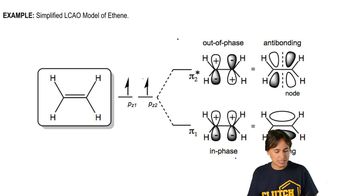
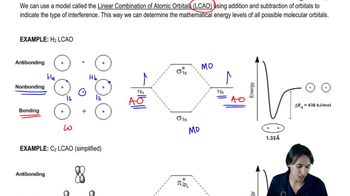
Molecular Orbital Theory explains how atomic orbitals combine to form molecular orbitals, which can be occupied by electrons. When atomic orbitals overlap, they create a number of molecular orbitals equal to the number of atomic orbitals combined. These molecular orbitals can be classified as bonding or antibonding based on their energy levels and stability.
추천 영상:
08:41
Review of Molecular Orbitals

Bonding and Antibonding Orbitals

Bonding orbitals are formed when atomic orbitals combine constructively, leading to a lower energy state and increased stability for the molecule. In contrast, antibonding orbitals result from destructive interference of atomic orbitals, resulting in a higher energy state that destabilizes the molecule. The number of bonding and antibonding orbitals can be determined based on the specific interactions of the atomic orbitals involved.
추천 영상:
11:25
What’s the difference between atomic and molecular orbitals?

Conservation of Orbitals

The principle of conservation of orbitals states that the total number of molecular orbitals formed is equal to the total number of atomic orbitals that combine. For example, if 16 atomic orbitals overlap, 16 molecular orbitals will be created. These can be further divided into bonding and antibonding orbitals, typically with half being bonding and half being antibonding, depending on the specific molecular structure.
추천 영상:
08:41
Review of Molecular Orbitals