Ch. 21 - Conjugated Systems 1: Stability and Addition Reactions
Mullins - Organic Chemistry: A Learner Centered Approach 1st Edition
Mullins1st EditionOrganic Chemistry: A Learner Centered ApproachISBN: 9780137566471당신이 사용하는 게 아니라요?교과서 변경
20장, 문제 9

There were actually two possible products in the solvolysis reaction from Figure 21.10. Show both products. Which would you expect to be more stable? Why?
Chemical structure showing a chlorine atom and hydroxyl group with an arrow indicating two possible products from a solvolysis reaction.

검증된 단계별 안내
1
Identify the solvolysis reaction mechanism: Solvolysis typically involves a nucleophilic substitution reaction (SN1 or SN2) or elimination (E1 or E2). In this case, the reaction likely proceeds via an SN1 mechanism due to the mention of multiple products, which is common in SN1 reactions due to carbocation intermediates.
Determine the intermediate: In an SN1 reaction, the leaving group departs first, forming a carbocation intermediate. Analyze the structure of the starting material to determine the carbocation formed after the leaving group departs.
Consider carbocation rearrangement: Carbocations can rearrange to form a more stable carbocation (e.g., via hydride or alkyl shifts). Check if the initial carbocation can undergo rearrangement to form a more stable carbocation, such as a tertiary carbocation.
Predict the products: Once the carbocation intermediate(s) are identified, consider the nucleophile (solvent) attacking the carbocation. This can lead to two possible products: one from the direct attack on the initial carbocation and another from the attack on the rearranged carbocation.
Evaluate stability: Compare the stability of the two products. Stability is influenced by factors such as hyperconjugation, resonance, and steric hindrance. The more stable product is typically the major product due to thermodynamic control.

비슷한 문제에 대한 검증된 영상 답변:

이 영상 해법은 위 문제에 도움이 된다고 튜터들이 추천한 것입니다.
영상 길이:
6m

주요 개념

질문에 올바르게 답하기 위해 반드시 이해해야 하는 핵심 개념들은 다음과 같습니다.

Solvolysis Reaction

A solvolysis reaction is a type of nucleophilic substitution where a solvent acts as the nucleophile, typically resulting in the formation of an alcohol or other product. In organic chemistry, this process often involves the breaking of a carbon-leaving group bond and the formation of a new bond with the solvent. Understanding the mechanism of solvolysis, including factors like solvent polarity and nucleophilicity, is crucial for predicting the products formed.
추천 영상:
05:09
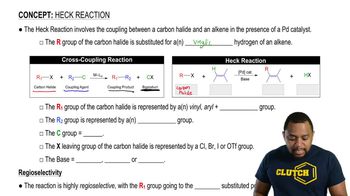
Heck Reaction

Stability of Reaction Products

The stability of reaction products in organic chemistry is influenced by factors such as steric hindrance, electronic effects, and resonance. More stable products are generally favored in reactions, as they have lower energy and are less reactive. In the context of solvolysis, the stability of the carbocation intermediate formed during the reaction can significantly affect the final products, with more substituted carbocations being more stable due to hyperconjugation and inductive effects.
추천 영상:
03:43
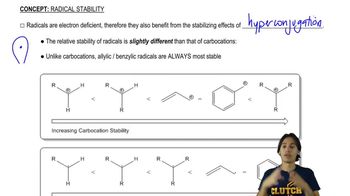
The radical stability trend.

Carbocation Stability

Carbocation stability is a key concept in organic chemistry, referring to the relative stability of positively charged carbon species. Carbocations can be classified as primary, secondary, or tertiary based on the number of alkyl groups attached to the positively charged carbon. Tertiary carbocations are the most stable due to greater hyperconjugation and inductive effects from surrounding alkyl groups, which help to disperse the positive charge, making them more favorable intermediates in reactions like solvolysis.
추천 영상:
05:58
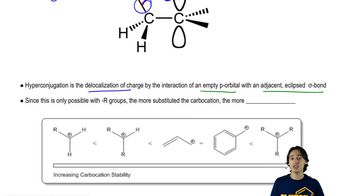
Determining Carbocation Stability