Ch. 4 - Acids and Bases/Electron Flow
Mullins - Organic Chemistry: A Learner Centered Approach 1st Edition
Mullins1st EditionOrganic Chemistry: A Learner Centered ApproachISBN: 9780137566471당신이 사용하는 게 아니라요?교과서 변경
3장, 문제 53

The nitrogen screened in purple in Figure 4.43 is not protonated at physiological pH. Why?
<IMAGE>

검증된 단계별 안내
1
Step 1: Identify the nitrogen atom in question (screened in purple in Figure 4.43) and note its chemical environment. This nitrogen is part of an amine group attached to a carbon chain.
Step 2: Consider the physiological pH, which is typically around 7.4. At this pH, amines are generally protonated due to their basic nature. However, the protonation depends on the electron density around the nitrogen atom.
Step 3: Analyze the inductive effects of nearby substituents. In this molecule, fluorine atoms are present near the nitrogen. Fluorine is highly electronegative and pulls electron density away from the nitrogen through the inductive effect, reducing the nitrogen's ability to accept a proton.
Step 4: Examine the resonance or steric effects. In this case, there is no significant resonance stabilization or steric hindrance directly affecting the nitrogen, but the reduced electron density due to the fluorine atoms makes the nitrogen less basic.
Step 5: Conclude that the nitrogen screened in purple is not protonated at physiological pH because the inductive effect of the fluorine atoms decreases its basicity, making it less likely to accept a proton under these conditions.

비슷한 문제에 대한 검증된 영상 답변:

이 영상 해법은 위 문제에 도움이 된다고 튜터들이 추천한 것입니다.

주요 개념

질문에 올바르게 답하기 위해 반드시 이해해야 하는 핵심 개념들은 다음과 같습니다.

Protonation

Protonation is the addition of a proton (H+) to a molecule, which can significantly alter its chemical properties. In organic chemistry, the protonation state of a molecule can affect its reactivity, solubility, and interaction with other molecules. Understanding the conditions under which protonation occurs, such as pH levels, is crucial for predicting the behavior of nitrogen-containing compounds.
추천 영상:
03:
Proton Splitting

Physiological pH

Physiological pH typically refers to the pH of human blood, which is around 7.4. At this pH, certain functional groups, including amines, may exist in their deprotonated form, affecting their charge and reactivity. Recognizing the significance of physiological pH helps in understanding the protonation states of biomolecules in biological systems.
추천 영상:
02:15
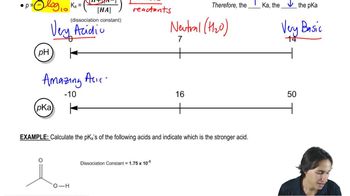
The pH scale vs. the pKa scale.

Basicity of Nitrogen

Nitrogen is a basic atom due to its lone pair of electrons, which can accept protons. However, the basicity can be influenced by the surrounding molecular environment and the presence of other functional groups. In the context of the question, the nitrogen's basicity at physiological pH determines whether it remains unprotonated, which is essential for understanding its role in biological molecules.
추천 영상:
가이드 코스
1:57
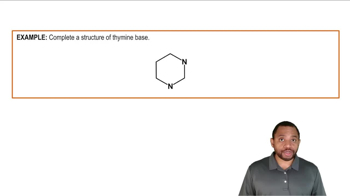
Nitrogenous Bases Example 2