Ch. 9 - Substitution and Elimination Reactions of Alkyl Halides
Bruice - Organic Chemistry 8th Edition
Bruice8th EditionOrganic ChemistryISBN: 9780135213711Not the one you use?Change textbook
Chapter 10, Problem 97

Which of following ethers cannot be made by a Williamson ether synthesis?

Verified step by step guidance
1
Step 1: Understand the Williamson ether synthesis mechanism. It involves the reaction of an alkoxide ion (RO⁻) with a primary or secondary alkyl halide (R'X) via an SN2 mechanism to form an ether (ROR').
Step 2: Analyze the structures of the ethers provided (i, ii, iii, iv). Look for steric hindrance in the alkyl halide component, as SN2 reactions are hindered by bulky groups.
Step 3: For ether (i), the alkyl groups attached to the oxygen are relatively bulky, but the synthesis is possible if the alkyl halide is not overly hindered.
Step 4: For ether (ii), the alkyl groups are highly branched, and the formation of this ether via Williamson synthesis is unlikely due to steric hindrance preventing the SN2 reaction.
Step 5: For ethers (iii) and (iv), the alkyl groups are less hindered compared to ether (ii, making their synthesis via Williamson ether synthesis more feasible. Thus, ether (ii) cannot be made by Williamson ether synthesis.

Verified video answer for a similar problem:

This video solution was recommended by our tutors as helpful for the problem above.
Video duration:
2m
Was this helpful?

Key Concepts

Here are the essential concepts you must grasp in order to answer the question correctly.

Williamson Ether Synthesis

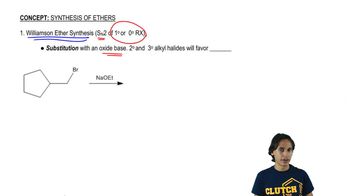
Williamson ether synthesis is a method for creating ethers through the reaction of an alkoxide ion with a primary alkyl halide. This reaction involves nucleophilic substitution, where the alkoxide acts as a nucleophile, attacking the electrophilic carbon of the alkyl halide. The reaction is most effective with primary halides to avoid steric hindrance and elimination reactions.
Recommended video:
Guided course
03:50
The Mechanism of Williamson Ether Synthesis.

Nucleophilicity and Sterics

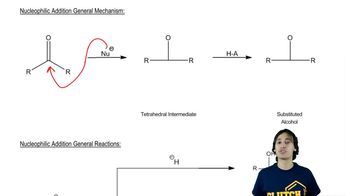
Nucleophilicity refers to the ability of a nucleophile to donate an electron pair to form a bond with an electrophile. In the context of Williamson ether synthesis, steric hindrance plays a crucial role; bulky nucleophiles or electrophiles can hinder the reaction. Therefore, primary alkyl halides are preferred to minimize steric effects, while secondary or tertiary halides may lead to elimination rather than substitution.
Recommended video:
Guided course
08:27
Nucleophilic Addition

Substitution Reactions

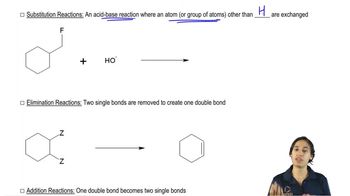
Substitution reactions involve the replacement of one functional group in a molecule with another. In Williamson ether synthesis, the reaction is typically an SN2 mechanism, where the nucleophile attacks the electrophile from the opposite side of the leaving group. Understanding the nature of the leaving group and the structure of the reactants is essential to predict the feasibility of the ether formation.
Recommended video:
Guided course
01:34
Recognizing Substitution Reactions.