Ch. 6 - The Reactions of Alkenes • The Stereochemistry of Addition Reactions
Bruice - Organic Chemistry 8th Edition
Bruice8th EditionOrganic ChemistryISBN: 9780135213711Not the one you use?Change textbook
Chapter 7, Problem 97

Which compound is hydrated more rapidly?

Verified step by step guidance
1
Step 1: Analyze the chemical structures provided. The first compound is isobutene (CH3CH=C(CH3)2), and the second compound is 3-chloro-2-methylpropene (ClCH2CH=C(CH3)2). Both compounds contain a double bond, which is the site of hydration.
Step 2: Recall the Markovnikov's rule for hydration reactions. In the presence of an acid catalyst, water adds to the double bond such that the hydrogen atom attaches to the carbon with more hydrogen atoms, and the hydroxyl group attaches to the carbon with fewer hydrogen atoms.
Step 3: Consider the electronic effects. The chlorine atom in the second compound is an electron-withdrawing group due to its electronegativity. This can stabilize the carbocation intermediate formed during the hydration process, making the second compound more reactive toward hydration.
Step 4: Evaluate steric effects. The presence of bulky groups near the double bond can hinder the approach of water molecules. In this case, both compounds have similar steric hindrance around the double bond, so steric effects are not a major differentiating factor.
Step 5: Conclude that the compound with the electron-withdrawing chlorine atom (3-chloro-2-methylpropene) is hydrated more rapidly due to the stabilization of the carbocation intermediate during the reaction.

Verified video answer for a similar problem:

This video solution was recommended by our tutors as helpful for the problem above.
Video duration:
4m
Was this helpful?

Key Concepts

Here are the essential concepts you must grasp in order to answer the question correctly.

Hydration Reaction

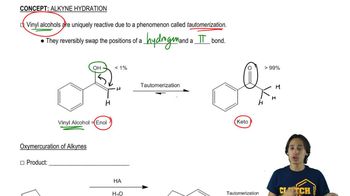
A hydration reaction involves the addition of water to a compound, typically resulting in the formation of a hydrate. This process is crucial in organic chemistry as it affects the stability and reactivity of compounds. The rate of hydration can depend on factors such as the structure of the compound and the presence of functional groups that can interact favorably with water.
Recommended video:
Guided course
09:11
Alkyne Hydration

Steric Hindrance

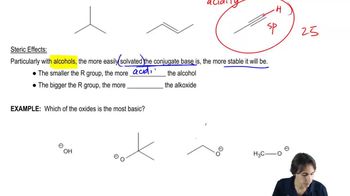
Steric hindrance refers to the prevention of chemical reactions due to the spatial arrangement of atoms within a molecule. Bulky groups can impede the approach of water molecules to the reactive site, thus slowing down the hydration process. Understanding steric effects is essential for predicting the reactivity of different compounds in hydration reactions.
Recommended video:
Guided course
02:53
Understanding steric effects.

Polarity and Solubility

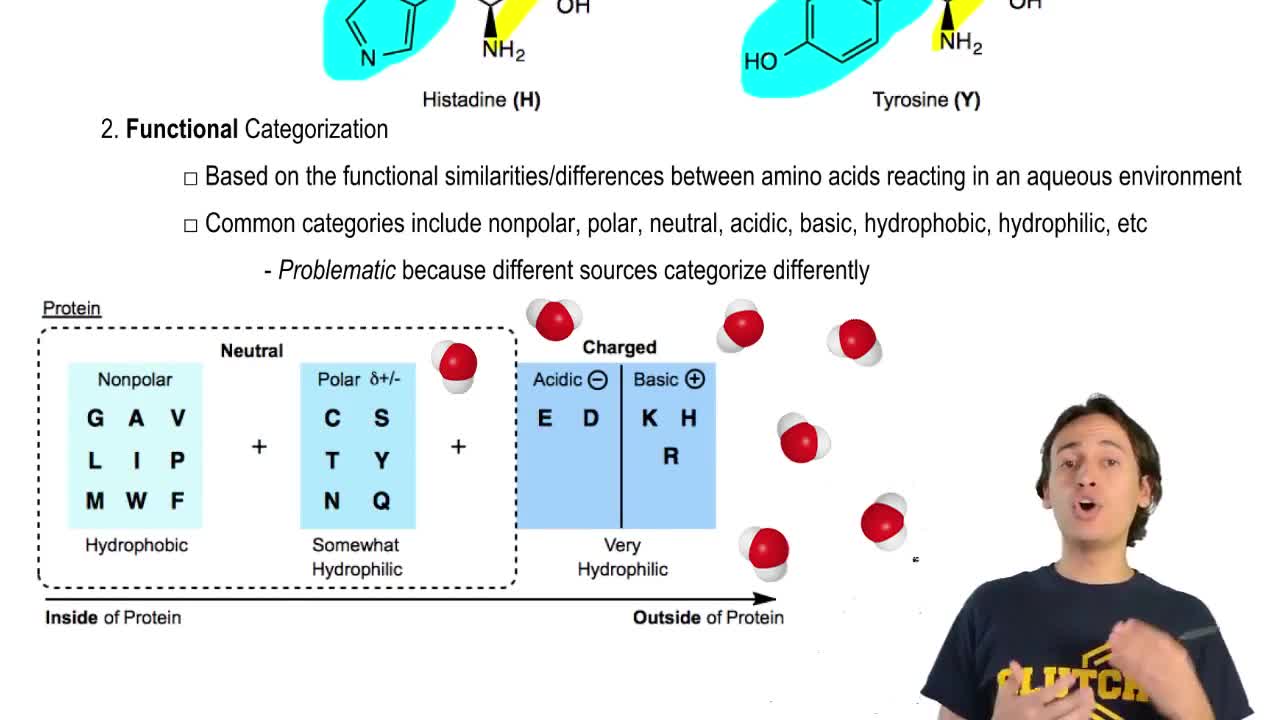
Polarity is a key factor in determining how well a compound interacts with water, which is a polar solvent. Compounds that are more polar or have functional groups capable of hydrogen bonding with water will generally hydrate more rapidly. This concept is vital for understanding the solubility and reactivity of organic compounds in aqueous environments.
Recommended video:
Guided course
07:13
Functional Classification