Ch.5 - Stereochemistry
Wade - Organic Chemistry 9th Edition
Wade9th EditionOrganic ChemistryISBN: 9780135213728Not the one you use?Change textbook
Chapter 5, Problem 5h

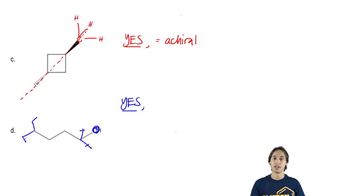
For each compound, determine whether the molecule has an internal mirror plane of symmetry. If it does, draw the mirror plane on a three-dimensional drawing of the molecule. If the molecule does not have an internal mirror plane, determine whether the structure is chiral.
(h) Diagram illustrating a three-dimensional molecule with a drawn mirror plane of symmetry.

Verified step by step guidance
1
Examine the given structure carefully. The molecule appears to be a bicyclic compound with two fused rings. Note the spatial arrangement of the substituents and the overall symmetry of the molecule.
Determine whether the molecule has an internal mirror plane of symmetry. A mirror plane divides the molecule into two halves that are mirror images of each other. Look for symmetry in the arrangement of atoms and substituents.
If a mirror plane exists, identify its location. For example, in this case, check if the plane passes through the central carbon atoms of the fused rings and bisects the molecule into two symmetrical halves.
If no internal mirror plane is found, assess whether the molecule is chiral. A chiral molecule lacks a plane of symmetry and has a non-superimposable mirror image. Consider the spatial arrangement of the substituents to determine chirality.
Conclude whether the molecule is achiral (if it has a mirror plane) or chiral (if it lacks a mirror plane and has a non-superimposable mirror image).

Verified video answer for a similar problem:

This video solution was recommended by our tutors as helpful for the problem above.
Video duration:
1m
Was this helpful?

Key Concepts

Here are the essential concepts you must grasp in order to answer the question correctly.

Mirror Plane of Symmetry

A mirror plane of symmetry is an imaginary plane that divides a molecule into two mirror-image halves. If a molecule possesses this symmetry, it means that one half is a reflection of the other, indicating that the molecule is achiral. Identifying this plane is crucial for determining the symmetry properties of the molecule.
Recommended video:
Guided course
02:58
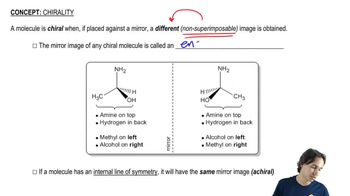
Determining Chirality with Plane of Symmetry

Chirality

Chirality refers to the property of a molecule that makes it non-superimposable on its mirror image, much like left and right hands. A chiral molecule lacks an internal mirror plane of symmetry and typically has at least one chiral center, often a carbon atom bonded to four different substituents. Understanding chirality is essential for predicting the behavior of molecules in biological systems.
Recommended video:
Guided course
05:10
What is chirality?

Three-Dimensional Molecular Representation

Three-dimensional molecular representation involves visualizing molecules in three-dimensional space to better understand their geometry and spatial arrangement. This representation is vital for identifying symmetry elements, such as mirror planes, and assessing chirality. Tools like molecular models or software can aid in accurately depicting these structures.
Recommended video:
Guided course
07:44
Molecular Geometry Explained.
Related Practice