Ch. 10 - Reactions of Alcohols, Ethers, Epoxides, Amines, and Sulfur-Containing Compounds
Bruice - Organic Chemistry 8th Edition
Bruice8th EditionOrganic ChemistryISBN: 9780135213711Not the one you use?Change textbook
Chapter 11, Problem 69c

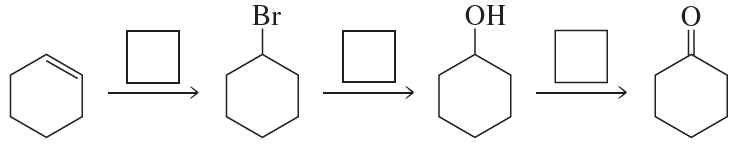
Fill in each box with the appropriate reagent:
c. Diagram showing a series of chemical structures with arrows indicating reactions and boxes for reagents to be filled in.

Verified step by step guidance
1
Step 1: Analyze the first transformation. The starting material is a cyclopropene, and the product is a cyclopropyl bromide. This suggests the addition of HBr across the double bond in the cyclopropene. The reagent for this step is hydrobromic acid (HBr).
Step 2: Examine the second transformation. The cyclopropyl bromide is converted into cyclopropanol. This indicates a substitution reaction where the bromine atom is replaced by a hydroxyl group. The reagent for this step is aqueous sodium hydroxide (NaOH) or another nucleophile like water under basic conditions.
Step 3: Analyze the third transformation. The cyclopropanol is oxidized to a cyclopropanone. This suggests the use of an oxidizing agent. Common oxidizing agents for alcohols include PCC (Pyridinium chlorochromate) or Jones reagent (CrO3/H2SO4).
Step 4: Ensure that the reagents chosen for each step are compatible with the functional groups present and the desired transformations. For example, HBr is suitable for electrophilic addition, NaOH for nucleophilic substitution, and PCC for mild oxidation.
Step 5: Confirm the sequence of reactions and verify that the reagents chosen will lead to the desired products without side reactions or over-oxidation. This ensures the correct transformation of cyclopropene to cyclopropanone.

Verified video answer for a similar problem:

This video solution was recommended by our tutors as helpful for the problem above.
Video duration:
4m
Was this helpful?

Key Concepts

Here are the essential concepts you must grasp in order to answer the question correctly.

Retrosynthesis

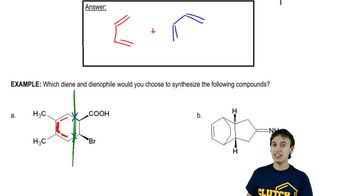
Retrosynthesis is a strategy in organic chemistry used to deconstruct complex molecules into simpler precursor structures. This approach helps chemists identify the necessary reagents and reaction pathways to synthesize a target compound. By working backward from the desired product, chemists can plan a synthetic route that includes the selection of appropriate reagents for each step.
Recommended video:
Guided course
01:22
Retrosynthesis

Reagents in Organic Reactions

Reagents are substances that are added to a chemical reaction to cause a transformation. In organic chemistry, different reagents can facilitate various types of reactions, such as nucleophilic substitutions, eliminations, or additions. Understanding the role of specific reagents, such as bromine (Br) for halogenation or hydroxyl groups (OH) for hydration, is crucial for predicting the outcome of reactions and filling in the gaps in retrosynthetic analysis.
Recommended video:
Guided course
02:17
Identifying organic molecules

Functional Groups

Functional groups are specific groups of atoms within molecules that are responsible for the characteristic chemical reactions of those molecules. Common functional groups include alcohols (–OH), halides (–Br), and carbonyls (C=O). Recognizing functional groups is essential for understanding how different reagents will interact with a molecule during synthesis and for predicting the products of chemical reactions.
Recommended video:
Guided course
02:36
Identifying Functional Groups