Ch. 7 - Structure and Synthesis of Alkenes; Elimination
Wade - Organic Chemistry 9th Edition
Wade9th EditionOrganic ChemistryISBN: 9780135213728Not the one you use?Change textbook
Chapter 7, Problem 34b

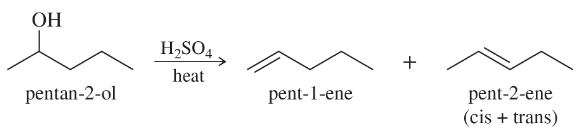
Propose mechanisms for the following reactions.
(b)

Verified step by step guidance
1
Step 1: Recognize that the reaction involves the dehydration of pentan-2-ol under acidic conditions (H2SO4 and heat). Dehydration reactions typically proceed via an E1 mechanism, where the alcohol is protonated to form a good leaving group (water).
Step 2: Protonation of the hydroxyl group (-OH) occurs first. The sulfuric acid donates a proton (H⁺) to the hydroxyl group, converting it into a better leaving group, water (H₂O). This step forms a positively charged intermediate.
Step 3: The water molecule leaves, generating a carbocation intermediate at the second carbon. This carbocation is secondary and relatively stable, but it can undergo rearrangement if a more stable carbocation is possible. In this case, no rearrangement occurs.
Step 4: Elimination of a proton (H⁺) from a β-carbon adjacent to the carbocation occurs, forming a double bond. The elimination can happen in two different directions: (a) elimination from the first carbon forms pent-1-ene, and (b) elimination from the third carbon forms pent-2-ene. Pent-2-ene exists as cis and trans isomers due to restricted rotation around the double bond.
Step 5: The final products are pent-1-ene and pent-2-ene (cis and trans). The reaction follows Zaitsev's rule, favoring the formation of the more substituted alkene (pent-2-ene) as the major product.

Verified video answer for a similar problem:

This video solution was recommended by our tutors as helpful for the problem above.
Video duration:
8m

Key Concepts

Here are the essential concepts you must grasp in order to answer the question correctly.

Elimination Reactions

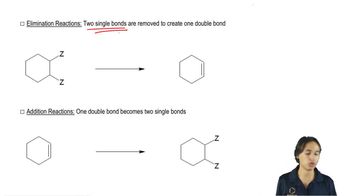
Elimination reactions involve the removal of atoms or groups from a molecule, resulting in the formation of a double bond. In this case, the reaction of pentan-2-ol with sulfuric acid under heat leads to the elimination of water, producing alkenes. Understanding the mechanism of elimination is crucial for predicting the products formed in this reaction.
Recommended video:
00:40
Recognizing Elimination Reactions.

E1 Mechanism

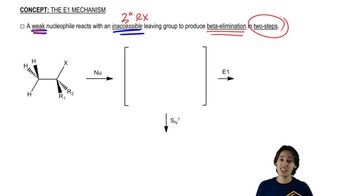
The E1 mechanism is a two-step elimination process where the first step involves the formation of a carbocation intermediate after the leaving group departs. In the presence of heat and an acid like H2SO4, pentan-2-ol undergoes dehydration to form a carbocation, which then loses a proton to form the alkene. Recognizing this mechanism helps in understanding the regioselectivity and stereochemistry of the products.
Recommended video:
08:09
Drawing the E1 Mechanism.

Regioselectivity and Stereochemistry

Regioselectivity refers to the preference of a chemical reaction to yield one structural isomer over others, while stereochemistry deals with the spatial arrangement of atoms in molecules. In the dehydration of pentan-2-ol, both pent-1-ene and pent-2-ene (cis and trans) are formed, showcasing how the reaction can lead to different products based on the stability of intermediates and the orientation of the double bond.
Recommended video:
Guided course
1:38
Polymer Stereochemistry Concept 1