Ch. 28 - Pericyclic Reactions
Bruice - Organic Chemistry 8th Edition
Bruice8th EditionOrganic ChemistryISBN: 9780135213711Not the one you use?Change textbook
Chapter 25, Problem 8b(2)

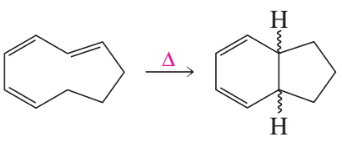
b. Are the indicated hydrogens cis or trans?
2. Chemical structures illustrating a reaction with indicated hydrogens, questioning their cis or trans configuration.

Verified step by step guidance
1
Identify the molecule's structure and locate the indicated hydrogens. Determine if the molecule contains a double bond or a ring system, as these are common scenarios where cis/trans isomerism occurs.
Understand the concept of cis and trans isomerism: In a double bond or ring system, 'cis' means the substituents (or hydrogens in this case) are on the same side of the plane, while 'trans' means they are on opposite sides.
Examine the spatial arrangement of the indicated hydrogens relative to the double bond or ring system. Use a 3D perspective or a molecular model if necessary to visualize their positions.
If the hydrogens are on the same side of the double bond or ring system, they are 'cis.' If they are on opposite sides, they are 'trans.'
Verify your conclusion by checking the molecular geometry and ensuring that the determination aligns with the definition of cis/trans isomerism.

Verified video answer for a similar problem:

This video solution was recommended by our tutors as helpful for the problem above.
Video duration:
3m
Was this helpful?

Key Concepts

Here are the essential concepts you must grasp in order to answer the question correctly.

Cis-Trans Isomerism

Cis-trans isomerism is a type of stereoisomerism where molecules with the same molecular formula have different spatial arrangements of atoms. In cis isomers, similar groups are on the same side of a double bond or ring structure, while in trans isomers, they are on opposite sides. This difference can significantly affect the physical and chemical properties of the compounds.
Recommended video:
Guided course
00:44
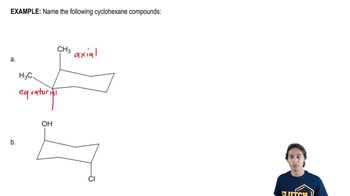
Is the following cyclohexane cis or trans?

Double Bonds and Restricted Rotation

Double bonds consist of one sigma bond and one pi bond, which restricts the rotation of the bonded atoms. This restriction is crucial for the formation of cis and trans isomers, as it allows for distinct spatial arrangements. Understanding this concept is essential for identifying the configuration of hydrogens in a given molecular structure.
Recommended video:
Guided course
06:00
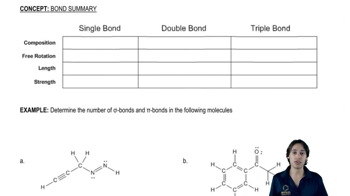
Single bonds, double bonds, and triple bonds.

Nomenclature of Alkenes

The nomenclature of alkenes involves naming compounds based on the position of the double bond and the arrangement of substituents. The terms 'cis' and 'trans' are used to describe the relative positions of substituents around the double bond. Familiarity with IUPAC naming conventions helps in accurately identifying and distinguishing between different isomers.
Recommended video:
4:02
Nomenclature of Heterocycles Concept 2