Give two positive and two negative angles that are coterminal with the given quadrantal angle. 0°
Ch. 1 - Trigonometric Functions
Chapter 2, Problem 100
Give two positive and two negative angles that are coterminal with the given quadrantal angle. 270°
Verified step by step guidance1
Understand that coterminal angles differ by full rotations of 360°. This means if you add or subtract multiples of 360° to the given angle, you get coterminal angles.
Start with the given angle, which is 270°, a quadrantal angle lying on the negative y-axis.
To find two positive coterminal angles, add 360° and 720° to 270° respectively, using the formula \(\theta + 360^\circ \times n\) where \(n\) is a positive integer.
To find two negative coterminal angles, subtract 360° and 720° from 270° respectively, using the formula \(\theta - 360^\circ \times n\) where \(n\) is a positive integer.
List the resulting angles as your two positive and two negative coterminal angles with 270°.

Verified video answer for a similar problem:
This video solution was recommended by our tutors as helpful for the problem above.
Video duration:
1mWas this helpful?
Key Concepts
Here are the essential concepts you must grasp in order to answer the question correctly.
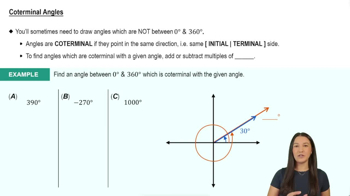
Coterminal Angles
Coterminal angles are angles that share the same initial and terminal sides but differ by full rotations of 360°. To find coterminal angles, you add or subtract multiples of 360° from the given angle. This concept helps identify angles that have the same trigonometric values.
Recommended video:
Coterminal Angles
Quadrantal Angles
Quadrantal angles are angles whose terminal sides lie along the x-axis or y-axis, typically at 0°, 90°, 180°, 270°, or 360°. These angles are important because their trigonometric values are often simple or undefined, and they serve as reference points in the coordinate plane.
Recommended video:
Quadratic Formula
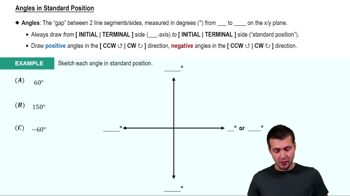
Positive and Negative Angles
Positive angles are measured counterclockwise from the positive x-axis, while negative angles are measured clockwise. Understanding this distinction is essential when finding coterminal angles, as you can add or subtract 360° to generate both positive and negative coterminal angles.
Recommended video:
Drawing Angles in Standard Position
Related Practice
Textbook Question
907
views
Textbook Question
Concept Check Suppose that ―90° < θ < 90° . Find the sign of each function value. sec θ/2
556
views
Textbook Question
If n is an integer, n • 180° represents an integer multiple of 180°, (2n + 1) • 90° represents an odd integer multiple of 90° , and so on. Determine whether each expression is equal to 0, 1, or ―1, or is undefined. sin[n • 180°]
591
views
Textbook Question
Concept Check Suppose that ―90° < θ < 90° . Find the sign of each function value.
sec(―θ)
531
views
Textbook Question
Write an expression that generates all angles coterminal with each angle. Let n represent any integer. 135°
572
views
Textbook Question
If n is an integer, n • 180° represents an integer multiple of 180°, (2n + 1) • 90° represents an odd integer multiple of 90° , and so on. Determine whether each expression is equal to 0, 1, or ―1, or is undefined. sin[270° + n • 360°]
604
views