Find all values of θ, if θ is in the interval [0°, 360°) and has the given function value. cos θ = -½
Ch. 2 - Acute Angles and Right Triangles
Chapter 3, Problem 19
Find exact values of the six trigonometric functions of each angle. Rationalize denominators when applicable. See Examples 2, 3, and 5. 300°
Verified step by step guidance1
Recognize that the angle 300° is in the fourth quadrant of the unit circle, where cosine is positive and sine is negative.
Find the reference angle by subtracting 300° from 360°, which gives \$360° - 300° = 60°$.
Recall the exact values of sine and cosine for the reference angle 60°: \(\sin 60° = \frac{\sqrt{3}}{2}\) and \(\cos 60° = \frac{1}{2}\).
Determine the sine and cosine of 300° using the signs in the fourth quadrant: \(\sin 300° = -\sin 60° = -\frac{\sqrt{3}}{2}\) and \(\cos 300° = \cos 60° = \frac{1}{2}\).
Calculate the remaining four trigonometric functions using the definitions: \(\tan 300° = \frac{\sin 300°}{\cos 300°}\), \(\csc 300° = \frac{1}{\sin 300°}\), \(\sec 300° = \frac{1}{\cos 300°}\), and \(\cot 300° = \frac{1}{\tan 300°}\). Remember to rationalize denominators where necessary.

Verified video answer for a similar problem:
This video solution was recommended by our tutors as helpful for the problem above.
Video duration:
4mWas this helpful?
Key Concepts
Here are the essential concepts you must grasp in order to answer the question correctly.
Unit Circle and Angle Measurement
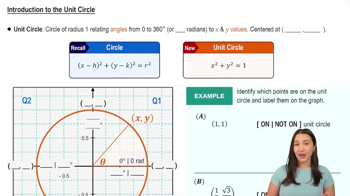
The unit circle is a circle with radius 1 centered at the origin, used to define trigonometric functions for all angles. Angles like 300° correspond to specific points on the unit circle, where coordinates (x, y) represent cosine and sine values respectively. Understanding how to locate angles on the unit circle is essential for finding exact trigonometric values.
Recommended video:
Introduction to the Unit Circle
Definition of the Six Trigonometric Functions
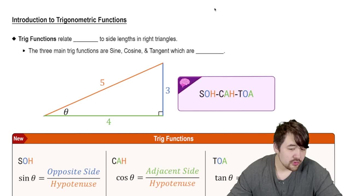
The six trigonometric functions are sine, cosine, tangent, cosecant, secant, and cotangent. Sine and cosine are based on the y and x coordinates of the unit circle point, while tangent is sine divided by cosine. The reciprocal functions (cosecant, secant, cotangent) are the inverses of sine, cosine, and tangent respectively, and knowing these definitions helps compute all values.
Recommended video:
Introduction to Trigonometric Functions
Rationalizing Denominators
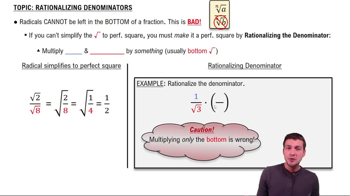
Rationalizing denominators involves eliminating radicals from the denominator of a fraction by multiplying numerator and denominator by a suitable expression. This process is important for expressing exact trigonometric values in a simplified and standardized form, especially when the denominator contains square roots, ensuring clarity and consistency in answers.
Recommended video:
Rationalizing Denominators
Related Practice
Textbook Question
667
views
Textbook Question
Solve each right triangle. When two sides are given, give angles in degrees and minutes.
512
views
Textbook Question
Evaluate each expression. Give exact values. tan² 120° - 2 cot 240°
570
views
Textbook Question
Find exact values of the six trigonometric functions of each angle. Rationalize denominators when applicable. See Examples 2, 3, and 5. 405°
721
views
Textbook Question
Find all values of θ, if θ is in the interval [0°, 360°) and has the given function value. sec θ = -2√3 3
630
views
Textbook Question
Suppose ABC is a right triangle with sides of lengths a, b, and c and right angle at C. Use the Pythagorean theorem to find the unknown side length. Then find exact values of the six trigonometric functions for angle B. Rationalize denominators when applicable. See Example 1. a = √2, c = 2
860
views