Table of contents
- 0. Review of College Algebra4h 45m
- 1. Measuring Angles40m
- 2. Trigonometric Functions on Right Triangles2h 5m
- 3. Unit Circle1h 19m
- 4. Graphing Trigonometric Functions1h 19m
- 5. Inverse Trigonometric Functions and Basic Trigonometric Equations1h 41m
- 6. Trigonometric Identities and More Equations2h 34m
- 7. Non-Right Triangles1h 38m
- 8. Vectors2h 25m
- 9. Polar Equations2h 5m
- 10. Parametric Equations1h 6m
- 11. Graphing Complex Numbers1h 7m
7. Non-Right Triangles
Law of Cosines
Problem 13
Textbook Question
Solve each triangle. Approximate values to the nearest tenth.
<IMAGE>
Verified step by step guidance1
Identify the given elements in the triangle: note which sides and angles are provided. Typically, you will have either two sides and an included angle (SAS), two angles and a side (ASA or AAS), or all three sides (SSS).
Use the Law of Sines or Law of Cosines depending on the given information. For example, if you have two sides and an included angle (SAS), use the Law of Cosines: \[\text{c}^2 = \text{a}^2 + \text{b}^2 - 2 \cdot \text{a} \cdot \text{b} \cdot \cos(\gamma)\] where \(\gamma\) is the included angle opposite side \(c\).
If you have an angle and its opposite side and another angle or side, use the Law of Sines: \[\frac{\sin(\alpha)}{a} = \frac{\sin(\beta)}{b} = \frac{\sin(\gamma)}{c}\] to find the missing sides or angles.
After finding one missing angle using the Law of Sines or Cosines, use the fact that the sum of angles in a triangle is \(180^\circ\) to find the remaining angle: \[\alpha + \beta + \gamma = 180^\circ\].
Once all angles and sides are found, round the values to the nearest tenth as requested.
Verified video answer for a similar problem:This video solution was recommended by our tutors as helpful for the problem above
Play a video:
0 Comments
Key Concepts
Here are the essential concepts you must grasp in order to answer the question correctly.
Triangle Classification and Properties
Understanding the types of triangles (right, acute, obtuse) and their properties is essential. This helps determine which trigonometric rules or formulas apply, such as the Pythagorean theorem for right triangles or the Law of Sines and Cosines for non-right triangles.
Recommended video:
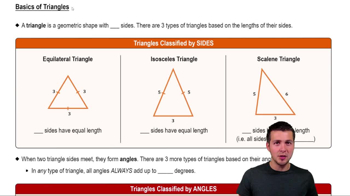
Review of Triangles
Law of Sines and Law of Cosines
These laws relate the sides and angles of any triangle, enabling the solution of unknown parts. The Law of Sines is useful when given two angles and one side or two sides and a non-included angle, while the Law of Cosines applies when two sides and the included angle or all three sides are known.
Recommended video:
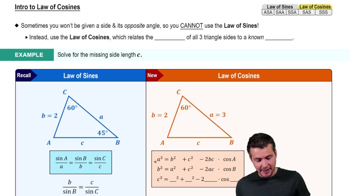
Intro to Law of Cosines
Angle and Side Approximation
After calculating angles or sides using trigonometric formulas, rounding to the nearest tenth is often required. This involves understanding significant figures and approximation techniques to present answers clearly and accurately.
Recommended video:
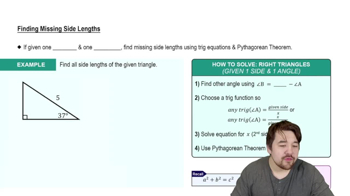
Finding Missing Side Lengths
Related Videos
Related Practice
Textbook Question
In Exercises 1–8, solve each triangle. Round lengths of sides to the nearest tenth and angle measures to the nearest degree.
460
views