Determine whether each equation is an identity, a conditional equation, or a contradiction. Give the solution set. See Example 4. 4(x + 7) = 2(x + 12) + 2(x + 1)
Table of contents
- 0. Review of College Algebra4h 45m
- 1. Measuring Angles40m
- 2. Trigonometric Functions on Right Triangles2h 5m
- 3. Unit Circle1h 19m
- 4. Graphing Trigonometric Functions1h 19m
- 5. Inverse Trigonometric Functions and Basic Trigonometric Equations1h 41m
- 6. Trigonometric Identities and More Equations2h 34m
- 7. Non-Right Triangles1h 38m
- 8. Vectors2h 25m
- 9. Polar Equations2h 5m
- 10. Parametric Equations1h 6m
- 11. Graphing Complex Numbers1h 7m
0. Review of College Algebra
Solving Linear Equations
Problem R.6.91
Textbook Question
Solve each inequality. Give the solution set using interval notation. See Example 10. -9 ≤ x + 5 ≤ 15
Verified step by step guidance1
Start with the compound inequality: \(-9 \leq x + 5 \leq 15\).
To isolate \(x\), subtract 5 from all three parts of the inequality: \(-9 - 5 \leq x + 5 - 5 \leq 15 - 5\).
Simplify each part: \(-14 \leq x \leq 10\).
Interpret the solution: \(x\) is greater than or equal to \(-14\) and less than or equal to \$10$.
Express the solution set in interval notation as \([-14, 10]\).
Verified video answer for a similar problem:This video solution was recommended by our tutors as helpful for the problem above
Video duration:
3mPlay a video:
0 Comments
Key Concepts
Here are the essential concepts you must grasp in order to answer the question correctly.
Compound Inequalities
Compound inequalities involve two inequalities combined into one statement, such as -9 ≤ x + 5 ≤ 15. Solving them requires isolating the variable by performing operations on all parts of the inequality simultaneously to maintain the inequality's truth.
Recommended video:
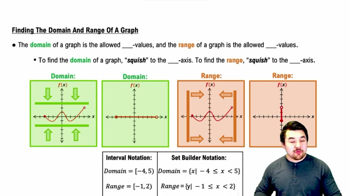
Finding the Domain and Range of a Graph
Properties of Inequalities
When solving inequalities, adding, subtracting, multiplying, or dividing all parts by the same positive number preserves the inequality direction. Multiplying or dividing by a negative number reverses the inequality signs. Understanding these properties ensures correct manipulation of inequalities.
Recommended video:
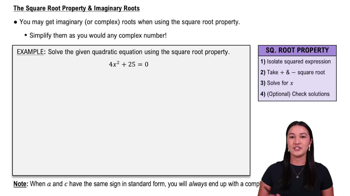
Imaginary Roots with the Square Root Property
Interval Notation
Interval notation expresses solution sets of inequalities concisely using brackets and parentheses. Brackets [ ] indicate inclusion of endpoints, while parentheses ( ) indicate exclusion. For example, [a, b] means all values from a to b, including a and b.
Recommended video:
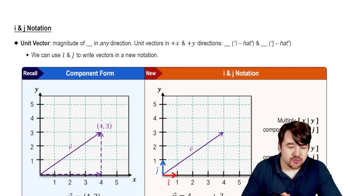
i & j Notation
Related Videos
Related Practice
Textbook Question
64
views