In Exercises 31–34, determine the amplitude of each function. Then graph the function and y = cos x in the same rectangular coordinate system for 0 ≤ x ≤ 2π. y = 2 cos x
Ch. 2 - Graphs of the Trigonometric Functions; Inverse Trigonometric Functions

All textbooks
Blitzer 3rd Edition
Ch. 2 - Graphs of the Trigonometric Functions; Inverse Trigonometric Functions
Problem 29
Blitzer 3rd Edition
Ch. 2 - Graphs of the Trigonometric Functions; Inverse Trigonometric Functions
Problem 29Chapter 2, Problem 29
In Exercises 29–44, graph two periods of the given cosecant or secant function. y = 3 csc x
Verified step by step guidance1
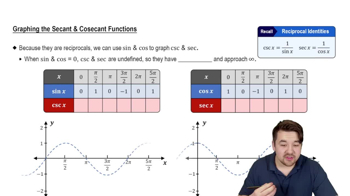
Recall that the cosecant function is the reciprocal of the sine function, so \(y = 3 \csc x\) can be written as \(y = \frac{3}{\sin x}\).
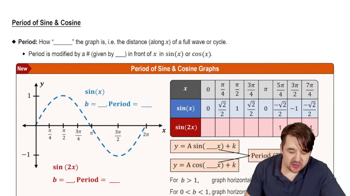
Identify the period of the basic \(\csc x\) function, which is \(2\pi\). Since there is no horizontal stretch or compression in \(y = 3 \csc x\), the period remains \(2\pi\).
To graph two periods, determine the interval over which to graph: from \(0\) to \(4\pi\) (since one period is \(2\pi\), two periods is \(4\pi\)).
Find the key points where \(\sin x = 0\) because \(\csc x\) is undefined there, causing vertical asymptotes. These occur at \(x = 0, \pi, 2\pi, 3\pi, 4\pi\) within the interval.
Plot the reciprocal values of \(\sin x\) scaled by 3, noting that the graph will have branches going to \(\pm \infty\) near the vertical asymptotes, and the minimum and maximum values of \(y = 3 \csc x\) correspond to \(y = \pm 3\) at points where \(\sin x = \pm 1\).

Verified video answer for a similar problem:
This video solution was recommended by our tutors as helpful for the problem above.
Video duration:
18mWas this helpful?
Key Concepts
Here are the essential concepts you must grasp in order to answer the question correctly.
Understanding the Cosecant Function
The cosecant function, csc(x), is the reciprocal of the sine function, defined as csc(x) = 1/sin(x). It is undefined where sin(x) = 0, leading to vertical asymptotes at these points. Recognizing its behavior helps in accurately sketching its graph.
Recommended video:
Graphs of Secant and Cosecant Functions
Periodicity of Trigonometric Functions
The period of the basic cosecant function is 2π, meaning the function repeats its values every 2π units along the x-axis. Graphing two periods involves plotting the function over an interval of length 4π to capture two full cycles.
Recommended video:
Period of Sine and Cosine Functions
Amplitude and Vertical Stretch
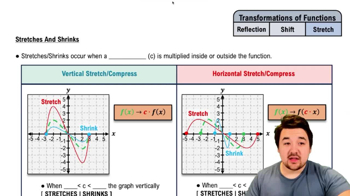
The coefficient 3 in y = 3 csc x vertically stretches the graph by a factor of 3. This affects the distance of the graph's branches from the x-axis, increasing the minimum and maximum values of the function's range accordingly.
Recommended video:
Stretches and Shrinks of Functions
Related Practice
Textbook Question
511
views
Textbook Question
In Exercises 21–28, an object moves in simple harmonic motion described by the given equation, where t is measured in seconds and d in inches. In each exercise, find the following: a. the maximum displacement b. the frequency c. the time required for one cycle. d = −4 sin 3π/2 t
1160
views
Textbook Question
Graph two periods of the given cosecant or secant function.
y = 2 csc x
865
views
Textbook Question
In Exercises 17–30, determine the amplitude, period, and phase shift of each function. Then graph one period of the function. y = −2 sin(2πx + 4π)
561
views
Textbook Question
In Exercises 27–38, use a calculator to find the value of each expression rounded to two decimal places. sin⁻¹ (-0.32)
800
views
Textbook Question
In Exercises 29–36, find the length x to the nearest whole unit.
462
views