Ch. 6 - Inverse Circular Functions and Trigonometric Equations
Lial - Trigonometry 12th Edition
Lial12th EditionTrigonometryISBN: 9780136552161Not the one you use?Change textbook
Chapter 7, Problem 89

Evaluate each expression without using a calculator.
sin (sin⁻¹ 1/2 + tan⁻¹ (-3))

Verified step by step guidance
1
Recognize that the expression is of the form \(\sin(\sin^{-1} x + \tan^{-1} y)\), where \(x = \frac{1}{2}\) and \(y = -3\). Our goal is to simplify this without a calculator.
Use the sine addition formula: \(\sin(A + B) = \sin A \cos B + \cos A \sin B\). Here, let \(A = \sin^{-1} \frac{1}{2}\) and \(B = \tan^{-1} (-3)\), so rewrite the expression as \(\sin A \cos B + \cos A \sin B\).
Find \(\sin A\) and \(\cos A\): Since \(A = \sin^{-1} \frac{1}{2}\), we know \(\sin A = \frac{1}{2}\). To find \(\cos A\), use the Pythagorean identity \(\cos A = \sqrt{1 - \sin^2 A} = \sqrt{1 - \left(\frac{1}{2}\right)^2}\).
Find \(\sin B\) and \(\cos B\): Since \(B = \tan^{-1} (-3)\), let \(\tan B = -3 = \frac{\sin B}{\cos B}\). Represent this as a right triangle with opposite side \(-3\) and adjacent side \(1\), then find the hypotenuse \(\sqrt{1^2 + (-3)^2} = \sqrt{10}\). Thus, \(\sin B = \frac{-3}{\sqrt{10}}\) and \(\cos B = \frac{1}{\sqrt{10}}\).
Substitute all values back into the sine addition formula: \(\sin A \cos B + \cos A \sin B = \left(\frac{1}{2}\right) \left(\frac{1}{\sqrt{10}}\right) + \left(\sqrt{1 - \left(\frac{1}{2}\right)^2}\right) \left(\frac{-3}{\sqrt{10}}\right)\). This expression can now be simplified step-by-step.

Verified video answer for a similar problem:

This video solution was recommended by our tutors as helpful for the problem above.
Was this helpful?

Key Concepts

Here are the essential concepts you must grasp in order to answer the question correctly.

Inverse Trigonometric Functions

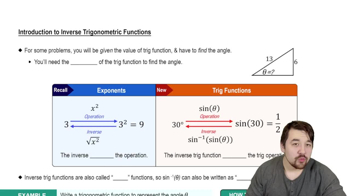
Inverse trigonometric functions, such as sin⁻¹ and tan⁻¹, return the angle whose trigonometric value is given. For example, sin⁻¹(1/2) gives the angle whose sine is 1/2. Understanding their ranges and outputs is essential for evaluating expressions involving these functions.
Recommended video:
4:28
Introduction to Inverse Trig Functions

Trigonometric Addition Formulas

The sine addition formula states that sin(A + B) = sin A cos B + cos A sin B. This formula allows the evaluation of the sine of a sum of two angles, which is necessary when simplifying expressions like sin(sin⁻¹ x + tan⁻¹ y).
Recommended video:
6:36
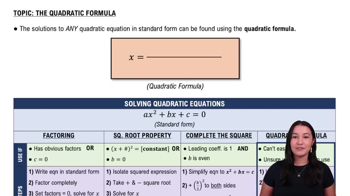
Quadratic Formula

Right Triangle Interpretation of Inverse Tangent

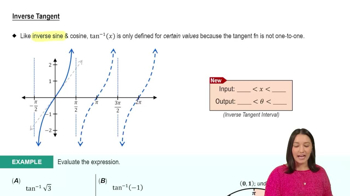
The inverse tangent function tan⁻¹(y) can be interpreted as an angle in a right triangle where the opposite side is y and the adjacent side is 1. This helps find sin and cos of tan⁻¹(y) by using the Pythagorean theorem, facilitating the evaluation of composite trigonometric expressions.
Recommended video:
3:17
Inverse Tangent