Ch. 7 - Applications of Trigonometry and Vectors
Lial - Trigonometry 12th Edition
Lial12th EditionTrigonometryISBN: 9780136552161Not the one you use?Change textbook
Chapter 8, Problem 24

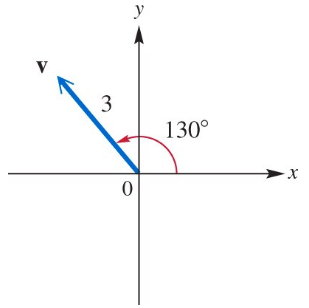
Write each vector in the form 〈a, b〉. Write answers using exact values or to four decimal places, as appropriate.


Vector v with magnitude 3 at a 130-degree angle from the positive x-axis on an xy-coordinate plane.

Verified step by step guidance
1
Identify the given vectors from the image and note their magnitudes and directions (angles) if provided.
Recall that a vector in the form \( \langle a, b \rangle \) can be expressed using its magnitude \( r \) and direction angle \( \theta \) as \( \langle r \cos(\theta), r \sin(\theta) \rangle \).
For each vector, calculate the \( a \) component by multiplying the magnitude by \( \cos(\theta) \), i.e., \( a = r \cos(\theta) \).
Similarly, calculate the \( b \) component by multiplying the magnitude by \( \sin(\theta) \), i.e., \( b = r \sin(\theta) \).
Write each vector in the form \( \langle a, b \rangle \) using exact values (like \( \sqrt{3}/2 \)) or decimal approximations rounded to four decimal places as appropriate.

Verified video answer for a similar problem:

This video solution was recommended by our tutors as helpful for the problem above.
Was this helpful?

Key Concepts

Here are the essential concepts you must grasp in order to answer the question correctly.

Vector Representation in Component Form

Vectors can be expressed as ordered pairs 〈a, b〉, where 'a' and 'b' represent the vector's horizontal and vertical components, respectively. This form simplifies vector operations like addition, subtraction, and scalar multiplication by working with components directly.
Recommended video:
03:55
Position Vectors & Component Form

Trigonometric Functions for Component Calculation

To find vector components from magnitude and direction, use trigonometric functions: the horizontal component is magnitude × cos(θ), and the vertical component is magnitude × sin(θ), where θ is the angle the vector makes with the positive x-axis.
Recommended video:
03:55
Position Vectors & Component Form

Exact Values and Decimal Approximations

When expressing vector components, exact values involve using known trigonometric ratios (like √2/2), while decimal approximations round these values to a specified number of decimal places, such as four, to balance precision and readability.
Recommended video:
6:04
Example 1