Ch. R - Algebra Review
Lial - Trigonometry 12th Edition
Lial12th EditionTrigonometryISBN: 9780136552161Not the one you use?Change textbook
Chapter 1, Problem 29

Graph each function. See Examples 1 and 2. h(x) = √4x

Verified step by step guidance
1
Identify the function to be graphed: \(h(x) = \sqrt{4x}\). This is a square root function where the expression inside the root is \$4x$.
Determine the domain of the function. Since the square root requires the radicand to be non-negative, set \(4x \geq 0\) which simplifies to \(x \geq 0\). So, the function is defined for all \(x\) greater than or equal to zero.
Create a table of values by choosing several \(x\) values within the domain (for example, \(x=0, 1, 2, 4\)) and calculate the corresponding \(h(x)\) values using \(h(x) = \sqrt{4x}\).
Plot the points from the table on the coordinate plane. For instance, when \(x=0\), \(h(0) = \sqrt{0} = 0\); when \(x=1\), \(h(1) = \sqrt{4} = 2\), and so on.
Draw a smooth curve through the plotted points starting at the origin \((0,0)\) and increasing to the right, reflecting the shape of the square root function which grows slowly as \(x\) increases.

Verified video answer for a similar problem:

This video solution was recommended by our tutors as helpful for the problem above.
Video duration:
4m
Was this helpful?

Key Concepts

Here are the essential concepts you must grasp in order to answer the question correctly.

Domain of a Function

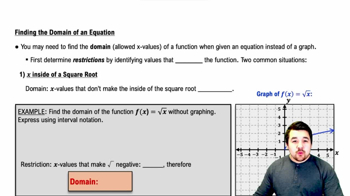
The domain is the set of all input values (x) for which the function is defined. For h(x) = √4x, the expression inside the square root must be non-negative, so 4x ≥ 0, meaning x ≥ 0. Understanding the domain ensures the graph only includes valid points.
Recommended video:
3:43
Finding the Domain of an Equation

Square Root Function

The square root function, √x, outputs the non-negative number whose square is x. It is defined only for x ≥ 0 and produces a curve starting at the origin and increasing slowly. Recognizing this shape helps in graphing h(x) = √4x by scaling the input.
Recommended video:
2:20
Imaginary Roots with the Square Root Property

Function Transformation and Scaling

Multiplying the input by a constant inside the function, as in √4x, affects the graph horizontally. Specifically, √4x = √(4 * x) = 2√x, which vertically stretches the basic square root graph by a factor of 2. Understanding transformations helps in accurately sketching the graph.
Recommended video:
4:22
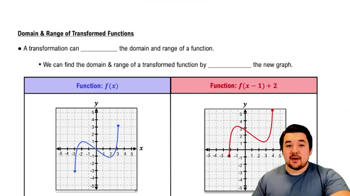
Domain and Range of Function Transformations