Ch. 4 - Laws of Sines and Cosines; Vectors
Blitzer - Trigonometry 3rd Edition
Blitzer3rd EditionTrigonometryISBN: 9780137316601Not the one you use?Change textbook
Chapter 4, Problem 5

In Exercises 5–12, sketch each vector as a position vector and find its magnitude. v = 3i + j

Verified step by step guidance
1
Identify the components of the vector \( \mathbf{v} = 3\mathbf{i} + \mathbf{j} \). Here, the vector has an x-component of 3 and a y-component of 1.
Sketch the vector on the Cartesian coordinate plane by starting at the origin (0,0). From the origin, move 3 units along the x-axis (horizontal direction) and 1 unit along the y-axis (vertical direction).
Draw an arrow from the origin to the point (3, 1). This arrow represents the position vector \( \mathbf{v} \).
To find the magnitude (length) of the vector \( \mathbf{v} \), use the Pythagorean theorem. The magnitude \( |\mathbf{v}| \) is given by the formula: \[ |\mathbf{v}| = \sqrt{(3)^2 + (1)^2} \]
Simplify the expression under the square root to get \( |\mathbf{v}| = \sqrt{9 + 1} \), which you can then evaluate to find the magnitude.

Verified video answer for a similar problem:

This video solution was recommended by our tutors as helpful for the problem above.
Video duration:
2m
Was this helpful?

Key Concepts

Here are the essential concepts you must grasp in order to answer the question correctly.

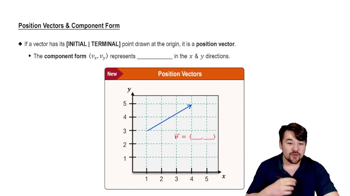
Position Vector

A position vector represents the location of a point in space relative to the origin. It is expressed in component form, such as v = 3i + j, where i and j are unit vectors along the x- and y-axes respectively. Sketching the vector involves plotting the point (3,1) and drawing an arrow from the origin to this point.
Recommended video:
03:55
Position Vectors & Component Form

Vector Components

Vector components break down a vector into its horizontal and vertical parts along the coordinate axes. For v = 3i + j, the components are 3 units in the x-direction and 1 unit in the y-direction. Understanding components helps in visualizing and calculating vector properties like magnitude and direction.
Recommended video:
03:55
Position Vectors & Component Form

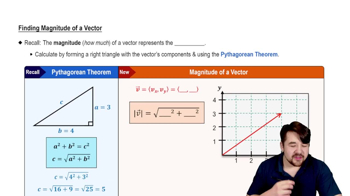
Magnitude of a Vector

The magnitude of a vector is its length, calculated using the Pythagorean theorem. For a vector v = ai + bj, the magnitude is |v| = √(a² + b²). In this case, |v| = √(3² + 1²) = √10, which quantifies the distance from the origin to the point (3,1).
Recommended video:
04:44
Finding Magnitude of a Vector