Ch. 5 - Complex Numbers, Polar Coordinates and Parametric Equations
Blitzer - Trigonometry 3rd Edition
Blitzer3rd EditionTrigonometryISBN: 9780137316601Not the one you use?Change textbook
Chapter 5, Problem 5.5.47

In Exercises 45–52, use your answers from Exercises 41–44 and the parametric equations given in Exercises 41–44 to find a set of parametric equations for the conic section or the line.


Ellipse: Center: (−2,3); Vertices: 5 units to the left and right of the center; Endpoints of Minor Axis: 2 units above and below the center

Verified step by step guidance
1
Identify the center of the ellipse as given: \((-2, 3)\).
Determine the lengths of the major and minor axes from the vertices and endpoints: the major axis length is \$5 + 5 = 10\( units, so the semi-major axis \)a = 5\(; the minor axis length is \)2 + 2 = 4\( units, so the semi-minor axis \)b = 2$.
Since the vertices are 5 units to the left and right of the center, the major axis is horizontal. This means the parametric equations will be based on \(x\) varying with cosine and \(y\) varying with sine.
Write the parametric equations for the ellipse centered at \((h, k)\) with horizontal major axis: \(x = h + a \cos(t)\) \(y = k + b \sin(t)\) where \(t\) is the parameter varying from \(0\) to \(2\pi\).
Substitute the known values \(h = -2\), \(k = 3\), \(a = 5\), and \(b = 2\) into the parametric equations to get the final set of parametric equations.

Verified video answer for a similar problem:

This video solution was recommended by our tutors as helpful for the problem above.
Video duration:
4m
Was this helpful?

Key Concepts

Here are the essential concepts you must grasp in order to answer the question correctly.

Parametric Equations of Conic Sections

Parametric equations express the coordinates of points on a curve as functions of a parameter, often denoted t. For conic sections like ellipses, these equations allow a clear representation of the curve by defining x and y in terms of trigonometric functions, simplifying analysis and graphing.
Recommended video:
08:02
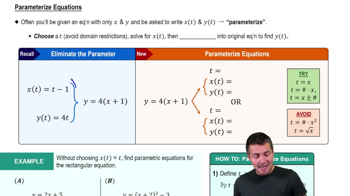
Parameterizing Equations

Ellipse Geometry and Parameters

An ellipse is defined by its center, vertices, and endpoints of the minor axis. The distance from the center to a vertex is the semi-major axis (a), and the distance to the minor axis endpoint is the semi-minor axis (b). These parameters determine the shape and size of the ellipse.
Recommended video:
05:59
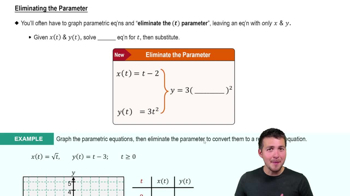
Eliminating the Parameter

Using Center and Axis Lengths to Form Parametric Equations

To write parametric equations for an ellipse, use the center coordinates as offsets and the semi-major and semi-minor axes as coefficients of cosine and sine functions, respectively. This approach translates geometric information into algebraic form for precise curve description.
Recommended video:
08:02
Parameterizing Equations