Ch. 5 - Trigonometric Identities
Lial - Trigonometry 12th Edition
Lial12th EditionTrigonometryISBN: 9780136552161Not the one you use?Change textbook
Chapter 6, Problem 22

Write each function value in terms of the cofunction of a complementary angle.
sin (2π/5)

Verified step by step guidance
1
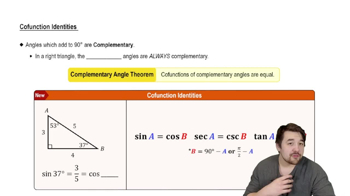
Recall the cofunction identity for sine and cosine: \(\sin(\theta) = \cos\left(\frac{\pi}{2} - \theta\right)\), where \(\theta\) is an angle in radians.
Identify the given angle \(\theta = \frac{2\pi}{5}\) and recognize that the complementary angle to \(\theta\) is \(\frac{\pi}{2} - \theta\).
Substitute \(\theta = \frac{2\pi}{5}\) into the complementary angle expression to get \(\frac{\pi}{2} - \frac{2\pi}{5}\).
Simplify the expression for the complementary angle by finding a common denominator: \(\frac{\pi}{2} = \frac{5\pi}{10}\) and \(\frac{2\pi}{5} = \frac{4\pi}{10}\), so the complementary angle is \(\frac{5\pi}{10} - \frac{4\pi}{10} = \frac{\pi}{10}\).
Express \(\sin\left(\frac{2\pi}{5}\right)\) as the cosine of the complementary angle: \(\sin\left(\frac{2\pi}{5}\right) = \cos\left(\frac{\pi}{10}\right)\).

Verified video answer for a similar problem:

This video solution was recommended by our tutors as helpful for the problem above.
Was this helpful?

Key Concepts

Here are the essential concepts you must grasp in order to answer the question correctly.

Cofunction Identity

Cofunction identities relate trigonometric functions of complementary angles, where the sum of the angles is π/2 radians (90°). For example, sin(θ) = cos(π/2 - θ). This allows expressing one function in terms of the cofunction of its complementary angle.
Recommended video:
6:30
Cofunction Identities

Complementary Angles

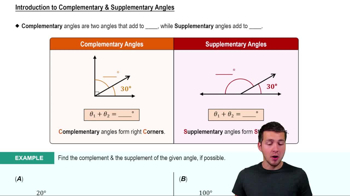
Two angles are complementary if their sum equals π/2 radians (90°). Understanding this relationship is essential for applying cofunction identities, as it defines the angle substitution needed to rewrite trigonometric functions.
Recommended video:
3:35
Intro to Complementary & Supplementary Angles

Radian Measure

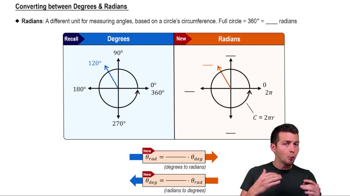
Radian measure is a way to express angles based on the radius of a circle. Since the question uses radians (2π/5), familiarity with radian values and conversions is important to correctly identify complementary angles and apply cofunction identities.
Recommended video:
5:04
Converting between Degrees & Radians