

Each of Exercises 67–88 gives the first derivative of a continuous function y=f(x). Find y'' and then use Steps 2–4 of the graphing procedure described in this section to sketch the general shape of the graph of f.
69. y' = x(x - 3)²
Verified step by step guidance
Each of Exercises 67–88 gives the first derivative of a continuous function y=f(x). Find y'' and then use Steps 2–4 of the graphing procedure described in this section to sketch the general shape of the graph of f.
69. y' = x(x - 3)²
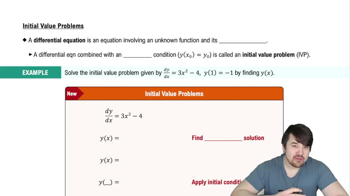
Initial Value Problems
Solve the initial value problems in Exercises 71–90.
dy/dx = 2x − 7, y(2) = 0
Theory and Examples
Determine the values of constants a and b so that f(x) = ax² + bx has an absolute maximum at the point (1,2).
30. Find a positive number for which the sum of its reciprocal and four times its square is the smallest possible.
Theory and Examples
67. An inequality for positive integers Show that if a, b, c, and d are positive integers, then
[(a^2+1)(b^2+1)(c^2+1)(d^2+1)]/abcd ≥ 16
Identifying Extrema
In Exercises 19–40:
a. Find the open intervals on which the function is increasing and those on which it is decreasing.
b. Identify the function’s local extreme values, if any, saying where they occur.
g(x) = x√8 − x²