Use the graph of y = f(x) to graph each function g. g(x) = -½ ƒ ( x + 2) - 2
Ch. 2 - Functions and Graphs

Chapter 3, Problem 41
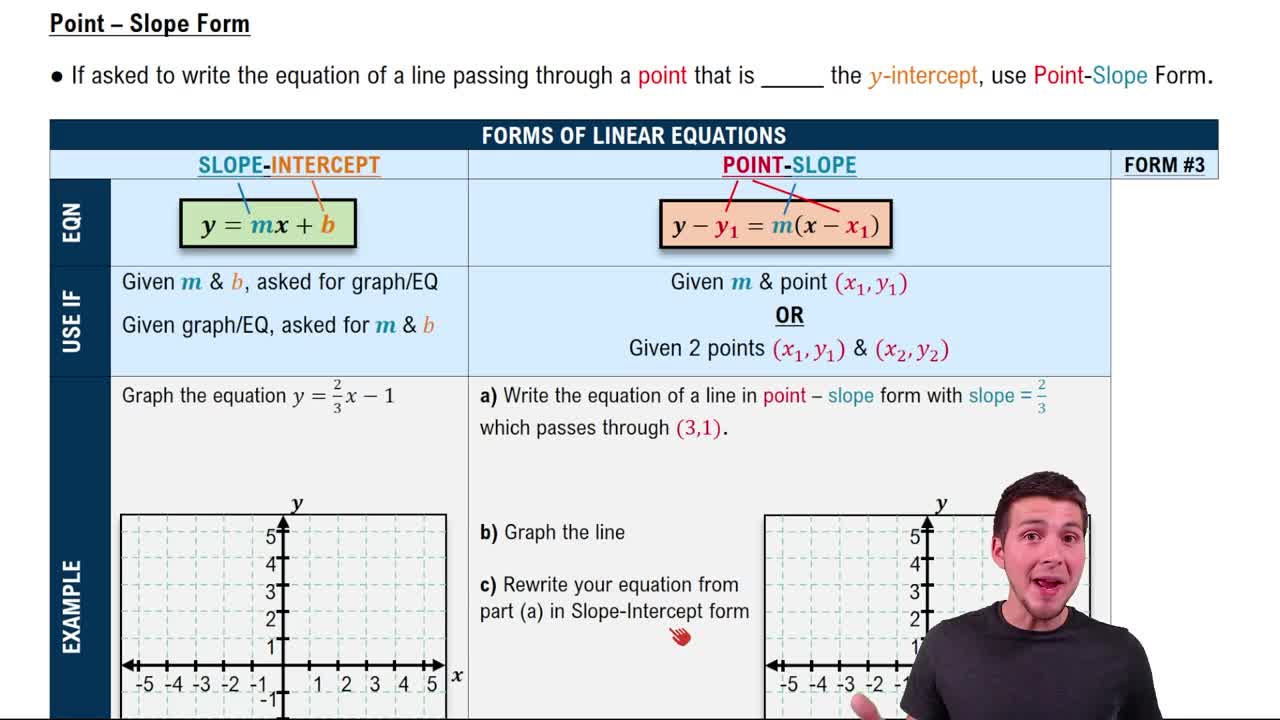
In Exercises 41–44, use the given conditions to write an equation for each line in point-slope form and slope-intercept form. Passing through (-3, 2) with slope - 6
Verified step by step guidance1
Identify the point-slope form of a linear equation, which is given by: , where is the slope and is a point on the line.
Substitute the given slope and the point into the point-slope form. This gives: .
Simplify the equation from step 2 to get the point-slope form: .
To convert to slope-intercept form, expand the equation from step 3. Distribute across , resulting in: .
Solve for by adding to both sides of the equation: . This is the slope-intercept form of the equation.

Verified video answer for a similar problem:
This video solution was recommended by our tutors as helpful for the problem above.
Video duration:
2mWas this helpful?
Key Concepts
Here are the essential concepts you must grasp in order to answer the question correctly.
Point-Slope Form
Point-slope form is a way to express the equation of a line given a point on the line and its slope. The formula is written as y - y1 = m(x - x1), where (x1, y1) is a point on the line and m is the slope. This form is particularly useful for quickly writing the equation of a line when you know a specific point and the slope.
Recommended video:
Guided course
Point-Slope Form
Slope-Intercept Form
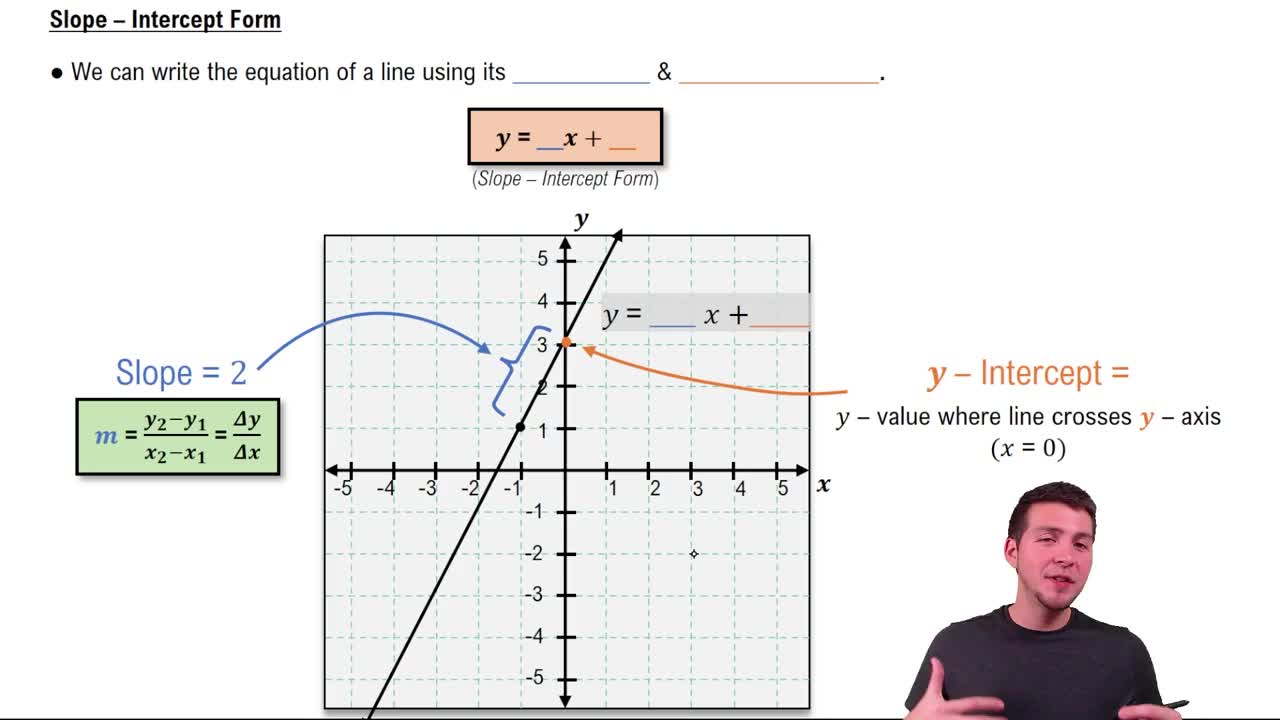
Slope-intercept form is another way to express the equation of a line, defined as y = mx + b, where m is the slope and b is the y-intercept. This form is beneficial for easily identifying the slope and where the line crosses the y-axis. Converting from point-slope to slope-intercept form allows for a clearer understanding of the line's behavior.
Recommended video:
Guided course
Slope-Intercept Form
Slope
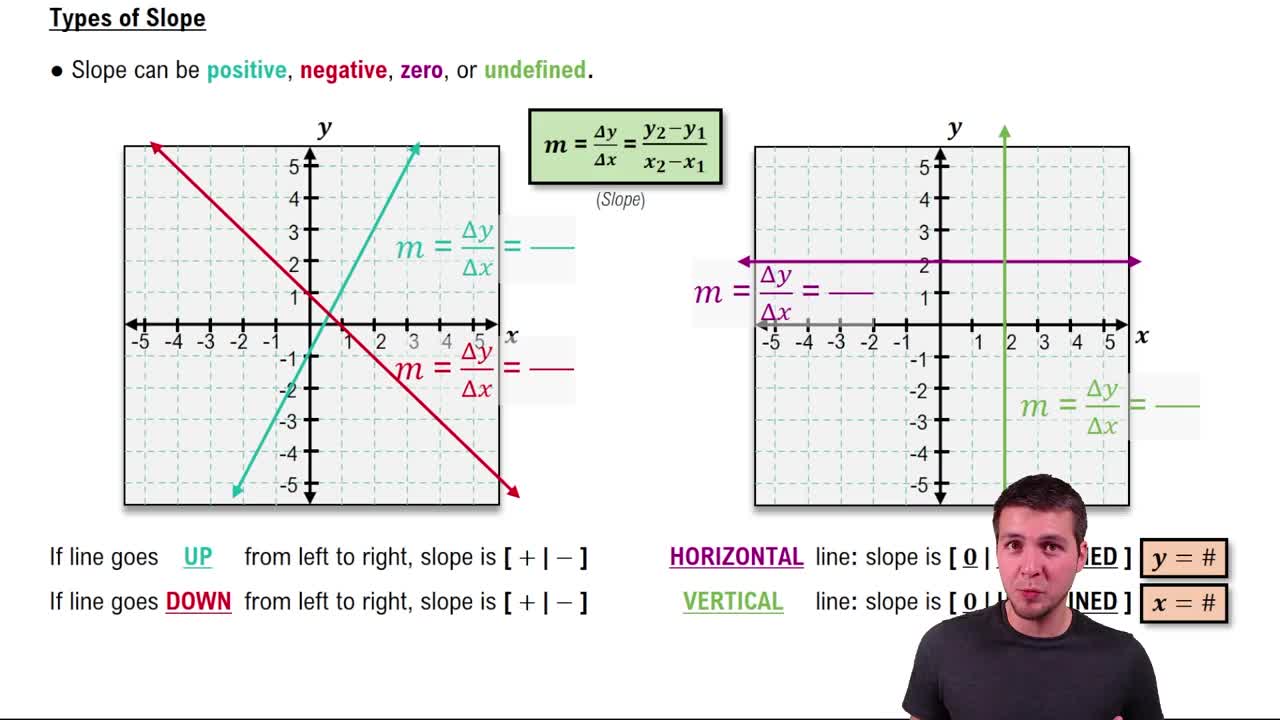
The slope of a line measures its steepness and direction, calculated as the change in y over the change in x (rise over run). A positive slope indicates the line rises as it moves from left to right, while a negative slope indicates it falls. In this question, the slope is given as -6, meaning for every unit increase in x, y decreases by 6 units, which is crucial for forming the line's equation.
Recommended video:
Guided course
Types of Slope
Related Practice
Textbook Question
602
views
Textbook Question
Find ƒ+g and determine the domain for each function. f(x) = 2 + 1/x, g(x) = 1/x
862
views
Textbook Question
Give the center and radius of the circle described by the equation and graph each equation. Use the graph to identify the relation's domain and range. x² + y² = 16
867
views
Textbook Question
Find , , , and . Determine the domain for each function.
,
717
views
Textbook Question
In Exercises 39–48, give the slope and y-intercept of each line whose equation is given. Then graph the linear function. f(x) = -2x+1
132
views
Textbook Question
Graph the given functions, f and g, in the same rectangular coordinate system. Select integers for x, starting with -2 and ending with 2. Once you have obtained your graphs, describe how the graph of g is related to the graph of f. f(x) = -2x, g(x) = -2x-1
625
views