Solve each polynomial inequality. Give the solution set in interval notation. x4 + 6x2 + 1 ≥ 4x3 + 4x
Ch. 3 - Polynomial and Rational Functions

Chapter 4, Problem 47
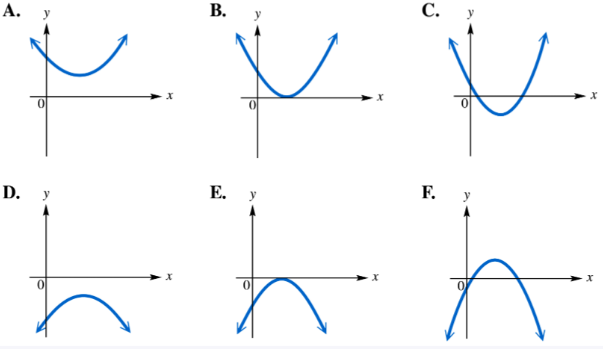
Several graphs of the quadratic function ƒ(x) = ax2 + bx + c are shown below. For the given restrictions on a, b, and c, select the corresponding graph from choices A–F. (Hint: Use the discriminant.) a < 0; b2 - 4ac < 0

Verified step by step guidance1
Recall the quadratic function is given by \(f(x) = ax^2 + bx + c\), where \(a\), \(b\), and \(c\) are constants.
Note the given conditions: \(a < 0\) and the discriminant \(b^2 - 4ac < 0\). The discriminant determines the nature of the roots of the quadratic equation.
Since \(a < 0\), the parabola opens downward, meaning the graph is concave down.
Because the discriminant \(b^2 - 4ac < 0\), the quadratic has no real roots, so the graph does not intersect the x-axis.
To select the correct graph, look for a downward-opening parabola that lies entirely above or below the x-axis without crossing it.

Verified video answer for a similar problem:
This video solution was recommended by our tutors as helpful for the problem above.
Video duration:
3mWas this helpful?
Key Concepts
Here are the essential concepts you must grasp in order to answer the question correctly.
Quadratic Function and Its Graph
A quadratic function is a polynomial of degree two, expressed as f(x) = ax^2 + bx + c. Its graph is a parabola that opens upward if a > 0 and downward if a < 0. The coefficients a, b, and c determine the shape and position of the parabola on the coordinate plane.
Recommended video:
Graphs of Logarithmic Functions
Discriminant of a Quadratic Equation
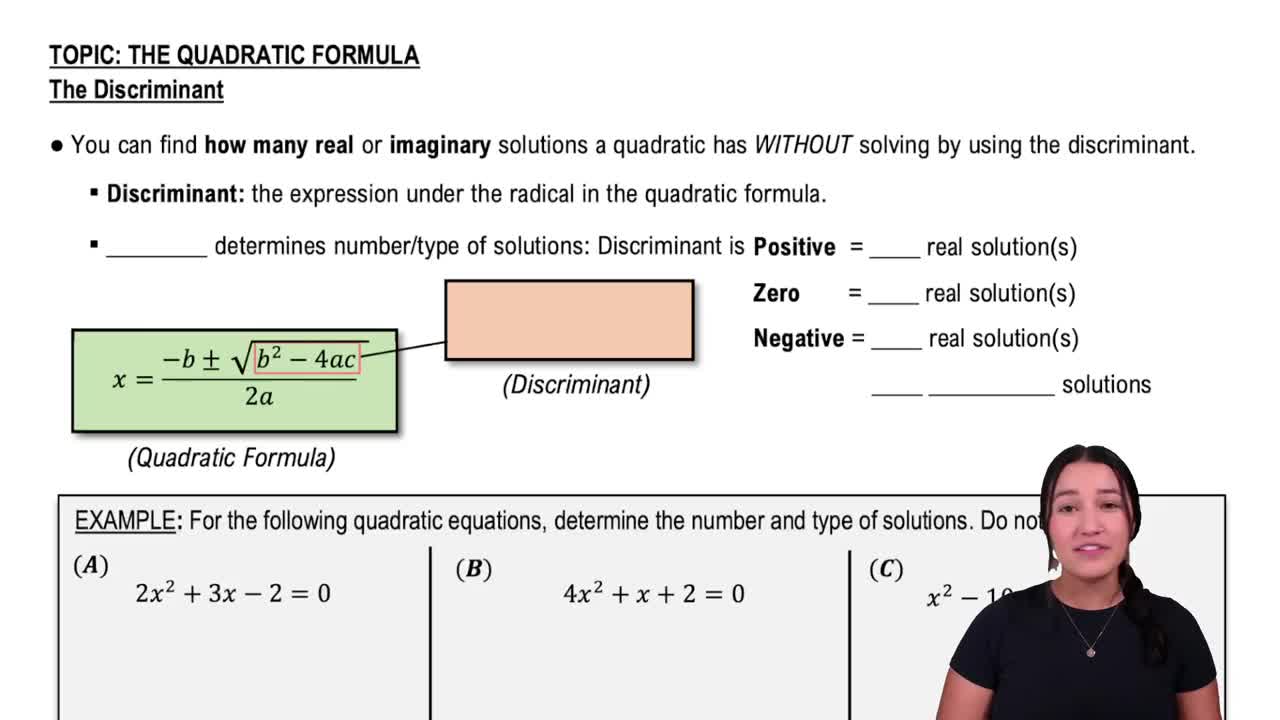
The discriminant, given by b^2 - 4ac, helps determine the nature of the roots of a quadratic equation. If the discriminant is less than zero, the quadratic has no real roots and the parabola does not intersect the x-axis. This information is crucial for identifying the correct graph.
Recommended video:
The Discriminant
Effect of Coefficients on the Parabola
The coefficient a controls the direction and width of the parabola, with a < 0 indicating it opens downward. The values of b and c affect the vertex's position and the parabola's vertical shift. Understanding these effects helps match the quadratic function to its graph under given restrictions.
Recommended video:
Horizontal Parabolas
Related Practice
Textbook Question
449
views
Textbook Question
Use synthetic division to determine whether the given number k is a zero of the polynomial function. If it is not, give the value of ƒ(k). ƒ(x) = x2 +2x -8; k=2
440
views
Textbook Question
Graph each polynomial function. ƒ(x)=(x-2)2(x+3)
921
views
Textbook Question
Give the equations of any vertical, horizontal, or oblique asymptotes for the graph of each rational function. ƒ(x)=(4x2+25)/(x2+9)
609
views
Textbook Question
Graph each polynomial function. Factor first if the polynomial is not in factored form. ƒ(x)=x4+3x3-3x2-11x-6
724
views
Textbook Question
If the given term is the dominating term of a polynomial function, what can we conclude about each of the following features of the graph of the function? (a) domain (b) range (c) end behavior (d) number of zeros (e) number of turning points -9x6
1066
views