Use the graph of y = f(x) to graph each function g. g(x) = -½ ƒ ( x + 2) - 2
Ch. 2 - Functions and Graphs

Chapter 3, Problem 41a
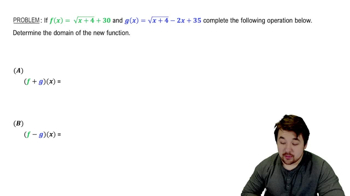
Find ƒ+g and determine the domain for each function. f(x) = 2 + 1/x, g(x) = 1/x
Verified step by step guidance1
Step 1: Understand the problem. You are tasked with finding the sum of two functions, f(x) and g(x), which is denoted as (f + g)(x). This means you need to add the two given functions together: f(x) = 2 + 1/x and g(x) = 1/x.
Step 2: Write the expression for (f + g)(x). Add the two functions together: (f + g)(x) = f(x) + g(x) = (2 + 1/x) + (1/x).
Step 3: Combine like terms. Simplify the expression by combining the terms involving 1/x: (f + g)(x) = 2 + 1/x + 1/x = 2 + 2/x.
Step 4: Determine the domain of the resulting function. The domain of a function is the set of all x-values for which the function is defined. For this problem, note that both f(x) and g(x) contain the term 1/x, which is undefined when x = 0. Therefore, the domain of (f + g)(x) excludes x = 0.
Step 5: Express the domain in interval notation. Since x = 0 is excluded, the domain is all real numbers except 0. In interval notation, this is written as (-∞, 0) ∪ (0, ∞).

Verified video answer for a similar problem:
This video solution was recommended by our tutors as helpful for the problem above.
Video duration:
3mWas this helpful?
Key Concepts
Here are the essential concepts you must grasp in order to answer the question correctly.
Function Addition
Function addition involves combining two functions by adding their outputs for each input. For functions f(x) and g(x), the sum is defined as (f + g)(x) = f(x) + g(x). This operation requires evaluating both functions at the same input value and summing the results.
Recommended video:
Adding & Subtracting Functions Example 1
Domain of a Function
The domain of a function is the set of all possible input values (x-values) for which the function is defined. For rational functions like f(x) = 2 + 1/x and g(x) = 1/x, the domain excludes values that make the denominator zero, as these would result in undefined outputs.
Recommended video:
Domain Restrictions of Composed Functions
Rational Functions
Rational functions are ratios of polynomials, expressed in the form f(x) = P(x)/Q(x), where P and Q are polynomials. The behavior of rational functions, including their domains and asymptotes, is influenced by the zeros of the denominator, which dictate where the function is undefined.
Recommended video:
Intro to Rational Functions
Related Practice
Textbook Question
602
views
Textbook Question
Find fg and determine the domain for each function. f(x) = 2 + 1/x, g(x) = 1/x
967
views
Textbook Question
In Exercises 41–44, use the given conditions to write an equation for each line in point-slope form and slope-intercept form. Passing through (-3, 2) with slope - 6
1162
views
Textbook Question
In Exercises 39-52, a. Find an equation for ƒ¯¹(x). b. Graph ƒ and ƒ¯¹(x) in the same rectangular coordinate system. c. Use interval notation to give the domain and the range of f and ƒ¯¹. ƒ(x) = x² − 4, x ≥ 0
666
views
Textbook Question
Give the center and radius of the circle described by the equation and graph each equation. Use the graph to identify the relation's domain and range. x² + y² = 16
867
views
Textbook Question
Find ƒ-g and determine the domain for each function. f(x) = 2 + 1/x, g(x) = 1/x
1063
views