Ch. 3 Cells: The Living Units
Marieb - Human Anatomy & Physiology 7th Edition
Marieb, Hoehn7th EditionHuman Anatomy & PhysiologyISBN: 9780805359091Not the one you use?Change textbook
Chapter 3, Problem 14

A nerve cell and a lymphocyte are presumed to differ in their:
a. Specialized structure
b. Suppressed genes and embryonic history
c. Genetic information
d. a and b, e. a and c

Verified step by step guidance
1
Step 1: Understand the question is asking about the differences between a nerve cell and a lymphocyte, which are two different types of cells in the body.
Step 2: Recall that all cells in an organism contain the same genetic information (DNA), so option c (Genetic information) is generally not a difference between these cells.
Step 3: Consider that nerve cells and lymphocytes have different specialized structures because they perform different functions, so option a (Specialized structure) is a valid difference.
Step 4: Recognize that these cells also differ in which genes are expressed or suppressed, and their embryonic origin (embryonic history), making option b (Suppressed genes and embryonic history) another valid difference.
Step 5: Combine the valid differences to identify the correct answer choice, which involves both specialized structure and suppressed genes/embryonic history, corresponding to option d (a and b).

Verified video answer for a similar problem:

This video solution was recommended by our tutors as helpful for the problem above.
Video duration:
2m
Was this helpful?

Key Concepts

Here are the essential concepts you must grasp in order to answer the question correctly.

Specialized Structure

Different cell types, like nerve cells and lymphocytes, have unique shapes and structures that suit their specific functions. For example, nerve cells have long extensions to transmit signals, while lymphocytes are round and adapted for immune responses.
Recommended video:
Guided course
5:05
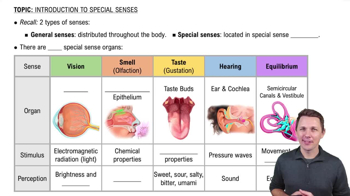
Special Senses

Gene Expression and Suppressed Genes

Although all cells contain the same DNA, different cells express different sets of genes. Some genes are suppressed or turned off depending on the cell type and its developmental history, leading to functional differences between cells like neurons and lymphocytes.
Recommended video:
Guided course
2:39
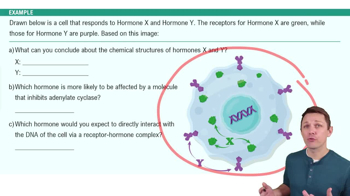
Intracellular Receptors and Direct Gene Action Example 1

Genetic Information

Genetic information refers to the DNA sequence within a cell. In multicellular organisms, all cells generally have identical genetic information, meaning nerve cells and lymphocytes share the same DNA despite their functional differences.
Recommended video:
01:28
Genetic Code