Ch. 3 Cells: The Living Units
Marieb - Human Anatomy & Physiology 7th Edition
Marieb, Hoehn7th EditionHuman Anatomy & PhysiologyISBN: 9780805359091Not the one you use?Change textbook
Chapter 3, Problem 18

Differentiate between primary and secondary active transport processes.

Verified step by step guidance
1
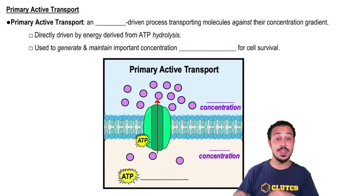
Step 1: Define primary active transport as the process where energy, usually from ATP hydrolysis, is directly used to move molecules against their concentration gradient through a membrane protein pump.
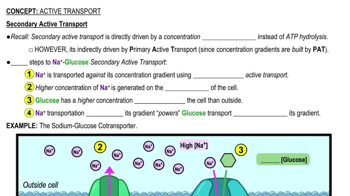
Step 2: Define secondary active transport as the process where the movement of one molecule down its concentration gradient provides the energy to transport another molecule against its gradient, without direct ATP usage.
Step 3: Explain that in primary active transport, the energy source is direct (e.g., ATP), while in secondary active transport, the energy is indirect, relying on the electrochemical gradient established by primary active transport.
Step 4: Differentiate the types of secondary active transport: symporters move two substances in the same direction, while antiporters move them in opposite directions.
Step 5: Summarize by highlighting that primary active transport creates the gradient, and secondary active transport uses that gradient to move other substances, emphasizing their interdependence in cellular processes.

Verified video answer for a similar problem:

This video solution was recommended by our tutors as helpful for the problem above.
Video duration:
3m
Was this helpful?

Key Concepts

Here are the essential concepts you must grasp in order to answer the question correctly.

Primary Active Transport

Primary active transport directly uses energy, usually from ATP hydrolysis, to move molecules against their concentration gradient. This process involves specific transport proteins like pumps, such as the sodium-potassium pump, which maintain essential cellular gradients.
Recommended video:
02:53
Primary Active Transport

Secondary Active Transport

Secondary active transport uses the energy stored in the electrochemical gradient created by primary active transport to move other substances against their gradient. It does not use ATP directly but relies on co-transporters or exchangers, such as symporters and antiporters.
Recommended video:
06:57
Secondary Active Transport

Concentration Gradient and Energy Coupling

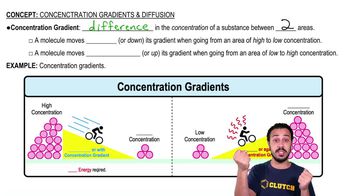
Both transport types move substances against their concentration gradients, requiring energy. Primary active transport uses ATP directly, while secondary active transport couples the movement of one molecule down its gradient to drive the uphill transport of another molecule.
Recommended video:
04:51
Concentration Gradients and Diffusion