Ch. 5 The Skeletal System
Marieb - Essentials of Human Anatomy & Physiology 13th Edition
Marieb13th EditionEssentials of Human Anatomy & PhysiologyISBN: 9780135624340Not the one you use?Change textbook
Chapter 5, Problem 11h

Match the types of joints to the descriptions that apply to them.
a. Fibrous joints
b. Cartilaginous joints
c. Synovial joints
8. Nearly all are synarthrotic

Verified step by step guidance
1
Understand the definitions of the three types of joints: Fibrous joints, Cartilaginous joints, and Synovial joints. Fibrous joints are connected by dense connective tissue and are typically immovable (synarthrotic). Cartilaginous joints are connected by cartilage and can be either immovable or slightly movable (amphiarthrotic). Synovial joints are freely movable (diarthrotic) and have a fluid-filled cavity.
Focus on the term 'synarthrotic,' which refers to joints that are immovable. This characteristic is most commonly associated with fibrous joints, such as sutures in the skull.
Evaluate whether cartilaginous joints can also be synarthrotic. Some cartilaginous joints, like the synchondroses (e.g., epiphyseal plates in growing bones), are immovable and thus synarthrotic.
Consider synovial joints. Synovial joints are typically diarthrotic (freely movable), so they do not match the description of being 'nearly all synarthrotic.'
Match the descriptions to the correct joint types. Based on the analysis, fibrous joints and some cartilaginous joints can be classified as 'nearly all synarthrotic.' Synovial joints do not fit this description.

Verified video answer for a similar problem:

This video solution was recommended by our tutors as helpful for the problem above.
Video duration:
2m
Was this helpful?

Key Concepts

Here are the essential concepts you must grasp in order to answer the question correctly.

Fibrous Joints

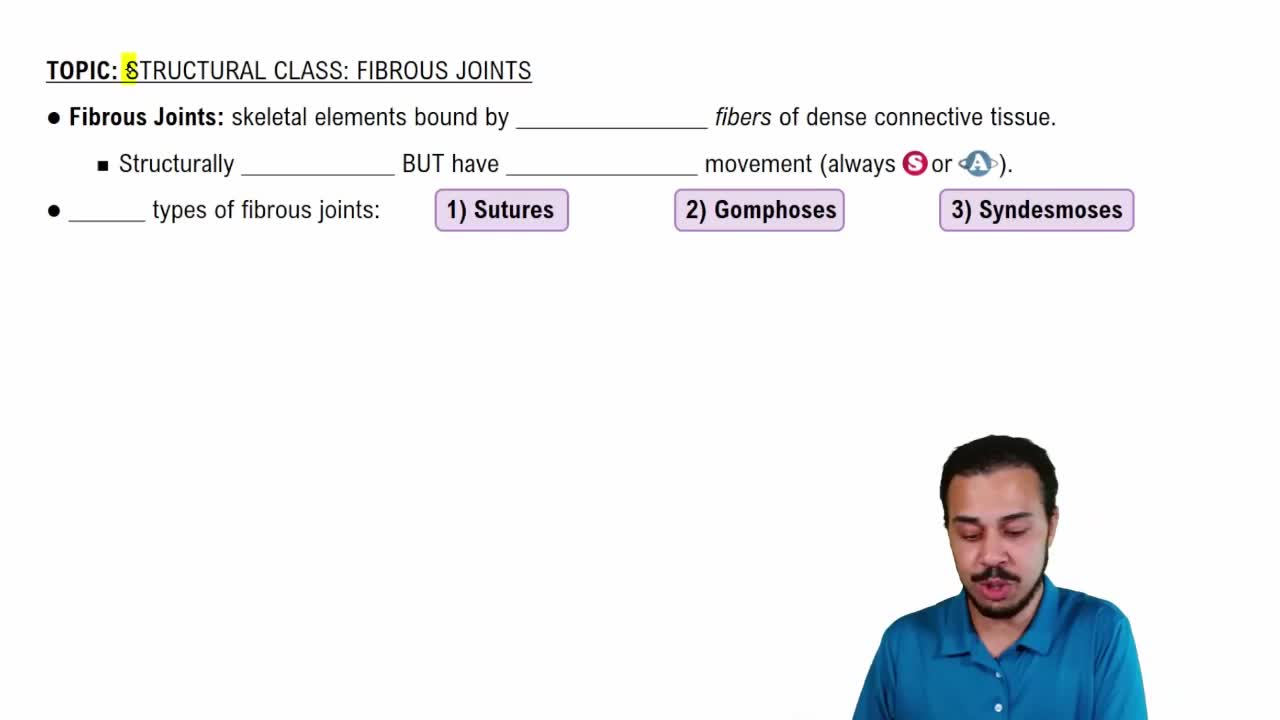
Fibrous joints are a type of joint where the bones are connected by dense connective tissue, primarily collagen. These joints are typically immovable (synarthrotic) and include structures such as sutures in the skull. They provide stability and strength, making them essential in areas where movement is not required.
Recommended video:
02:41
Introduction to Fibrous Joints

Cartilaginous Joints

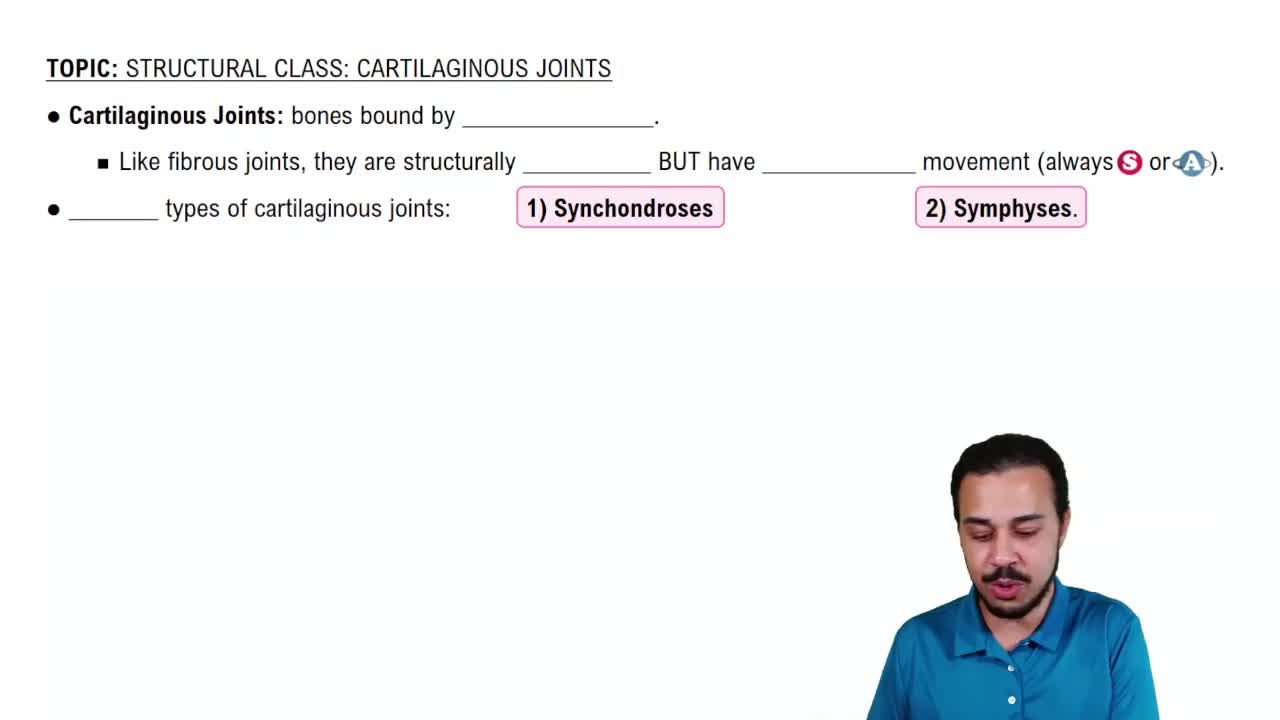
Cartilaginous joints are joints where the bones are connected by cartilage, allowing for limited movement. They can be classified into two types: synchondroses (immovable) and symphyses (slightly movable). An example is the pubic symphysis, which provides flexibility during childbirth while maintaining stability.
Recommended video:
02:17
Introduction to Cartilaginous Joints

Synovial Joints

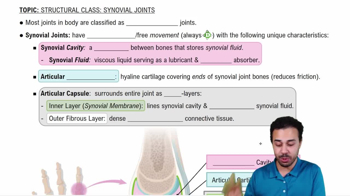
Synovial joints are the most common and movable type of joint in the body, characterized by a fluid-filled joint cavity. They allow for a wide range of motion and include various types such as hinge, ball-and-socket, and pivot joints. These joints are essential for activities requiring flexibility and movement, such as walking and grasping.
Recommended video:
8:20
Synovial Joints