Ch. 11 Fundamentals of the Nervous System and Nervous Tissue
Marieb - Human Anatomy & Physiology 7th Edition
Marieb, Hoehn7th EditionHuman Anatomy & PhysiologyISBN: 9780805359091Not the one you use?Change textbook
Chapter 11, Problem 21

The effects of neurotransmitter binding are very brief. Explain.

Verified step by step guidance
1
Understand that neurotransmitters are chemical messengers released from the presynaptic neuron into the synaptic cleft to transmit signals to the postsynaptic neuron or effector cell.
Recognize that the effects of neurotransmitter binding are brief because neurotransmitters are quickly removed from the synaptic cleft by mechanisms such as enzymatic degradation, reuptake into the presynaptic neuron, or diffusion away from the synapse.
Consider that this rapid removal prevents continuous stimulation of the postsynaptic receptors, allowing the neuron to reset and be ready for the next signal.
Note that the transient nature of neurotransmitter binding ensures precise control of neural communication, preventing overstimulation or prolonged activation of the postsynaptic cell.
Summarize that the brief effect is essential for proper nervous system function, enabling rapid and accurate transmission of information.

Verified video answer for a similar problem:

This video solution was recommended by our tutors as helpful for the problem above.
Video duration:
2m
Was this helpful?

Key Concepts

Here are the essential concepts you must grasp in order to answer the question correctly.

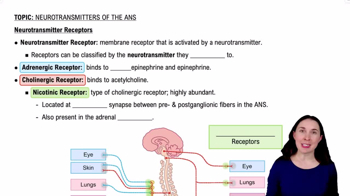
Neurotransmitter Binding

Neurotransmitter binding occurs when chemical messengers released from a neuron attach to specific receptors on a target cell, such as another neuron or muscle cell. This binding initiates a response, like opening ion channels or triggering intracellular signaling pathways, enabling communication between cells.
Recommended video:
2:30
Neurotransmitter Receptors

Synaptic Transmission Duration

The effects of neurotransmitter binding are brief because neurotransmitters are quickly removed from the synaptic cleft by reuptake, enzymatic degradation, or diffusion. This rapid clearance ensures that signals are transient, allowing neurons to reset and be ready for new signals.
Recommended video:
02:52
Types of Electron Microscopes

Receptor Desensitization and Signal Termination

Receptors can become desensitized after neurotransmitter binding, reducing their responsiveness to continuous stimulation. Additionally, cellular mechanisms actively terminate the signal to prevent prolonged activation, maintaining precise control over neural communication and preventing overstimulation.
Recommended video:
2:47
Sensory Receptors