Ch. 12 The Central Nervous System
Marieb - Human Anatomy & Physiology 7th Edition
Marieb, Hoehn7th EditionHuman Anatomy & PhysiologyISBN: 9780805359091Not the one you use?Change textbook
Chapter 12, Problem 10

List four ways in which the CNS is protected.

Verified step by step guidance
1
Understand that the Central Nervous System (CNS) consists of the brain and spinal cord, which are vital and delicate structures requiring protection from physical damage and infection.
Identify the first protective mechanism: the bony structures. The brain is protected by the skull, and the spinal cord is protected by the vertebral column, both providing a hard, physical barrier.
Recognize the second protection: the meninges, which are three layers of connective tissue membranes (dura mater, arachnoid mater, and pia mater) that surround and cushion the CNS.
Consider the third protection: cerebrospinal fluid (CSF), a clear fluid that circulates within the meninges and ventricles, acting as a shock absorber and providing a nutrient-rich environment.
Note the fourth protection: the blood-brain barrier, a selective permeability barrier formed by endothelial cells in CNS blood vessels that restricts harmful substances from entering the brain tissue.

Verified video answer for a similar problem:

This video solution was recommended by our tutors as helpful for the problem above.
Video duration:
1m
Was this helpful?

Key Concepts

Here are the essential concepts you must grasp in order to answer the question correctly.

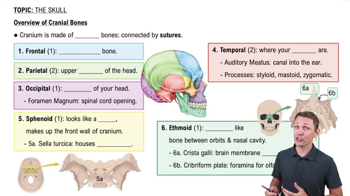
Cranial and Spinal Bones

The central nervous system (CNS) is protected by the skull and vertebral column, which provide a hard, bony shield against physical injury. The skull encases the brain, while the vertebrae surround the spinal cord, preventing direct trauma.
Recommended video:
Guided course
8:20
Overview of Cranial Bones

Meninges

Meninges are three layers of connective tissue membranes (dura mater, arachnoid mater, and pia mater) that envelop the brain and spinal cord. They provide cushioning, support, and a barrier against infections.
Recommended video:
2:10
Damaging Effects of the Inflammatory Response

Cerebrospinal Fluid (CSF)

CSF is a clear fluid circulating within the ventricles and around the CNS, acting as a shock absorber. It cushions the brain and spinal cord, removes waste, and helps maintain a stable chemical environment.
Recommended video:
Guided course
3:33
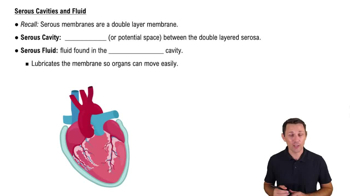
Serous Cavity and Fluid
Related Practice
Textbook Question

Fiber tracts that allow neurons within the same cerebral hemisphere to communicate are:

a. Association fibers

b. Commissures

c. Projection fibers

121
views
Textbook Question

A professor unexpectedly blew a loud horn in his anatomy and physiology class. The students looked up, startled. The reflexive movements of their eyes were mediated by the:

a. Cerebral cortex

b. Inferior olives

c. Raphe nuclei

d. Superior colliculi

e. Nucleus gracilis

959
views
1
rank
Textbook Question

a. What is the function of the basal nuclei?

b. Which basal nuclei form the striatum?

c. Which arches over the diencephalon?

36
views
Textbook Question

What constitutes the blood brain barrier?

1182
views
Textbook Question

A number of brain structures are listed below. If an area is primarily gray matter, write a in the answer blank; if mostly white matter, respond with b

________  (1) cerebral cortex 

________   (2) corpus callosum and corona radiata 

________   (3) red nucleus 

________   (4) medial and lateral nuclear groups 

________   (5) medial lemniscus 

________   (6) cranial nerve nuclei 

________   (7) spinothalamic tract 

________   (8) fornix 

________  (9) cingulate and precentral gyri

938
views
Textbook Question

A patient has suffered a cerebral hemorrhage that has caused dysfunction of the precentral gyrus of his right cerebral cortex. As a result:

a. He cannot voluntarily move his left arm or leg.

b. He feels no sensation on the left side of his body.

c. He feels no sensation on his right side.

851
views