Ch. 3 Cells: The Living Units
Marieb - Human Anatomy & Physiology 7th Edition
Marieb, Hoehn7th EditionHuman Anatomy & PhysiologyISBN: 9780805359091Not the one you use?Change textbook
Chapter 3, Problem 4

Osmosis always involves:
a. A selectively permeable membrane
b. A difference in solute concentration
c. Diffusion
d. Active transport
e. a, b, and c

Verified step by step guidance
1
Step 1: Understand the definition of osmosis. Osmosis is the movement of water molecules across a selectively permeable membrane from an area of lower solute concentration to an area of higher solute concentration.
Step 2: Identify the role of a selectively permeable membrane in osmosis. This membrane allows water molecules to pass through but restricts many solutes, which is essential for osmosis to occur.
Step 3: Recognize that osmosis requires a difference in solute concentration on either side of the membrane. This concentration gradient drives the movement of water.
Step 4: Note that osmosis is a type of diffusion, specifically the diffusion of water molecules, which is a passive process and does not require energy input.
Step 5: Understand that active transport is not involved in osmosis because active transport requires energy to move substances against their concentration gradient, whereas osmosis is passive.

Verified video answer for a similar problem:

This video solution was recommended by our tutors as helpful for the problem above.
Video duration:
2m
Was this helpful?

Key Concepts

Here are the essential concepts you must grasp in order to answer the question correctly.

Selectively Permeable Membrane

A selectively permeable membrane allows certain molecules to pass through while blocking others. In osmosis, this membrane permits the movement of water but restricts solute particles, enabling water to move toward higher solute concentration areas.
Recommended video:
6:43
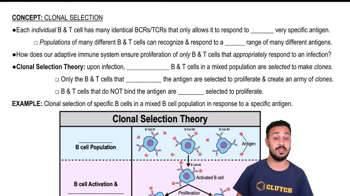
Clonal Selection

Difference in Solute Concentration

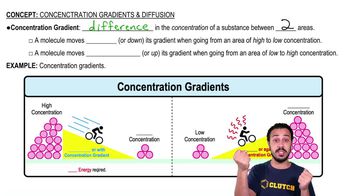
Osmosis occurs due to a concentration gradient where solute concentration differs on either side of the membrane. Water moves from the region of lower solute concentration to higher solute concentration to balance solute levels.
Recommended video:
04:51
Concentration Gradients and Diffusion

Diffusion

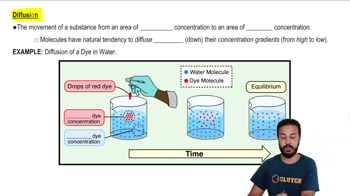
Diffusion is the passive movement of molecules from an area of higher concentration to lower concentration. Osmosis is a specific type of diffusion involving water molecules moving across a membrane to equalize solute concentrations.
Recommended video:
02:44
Diffusion