Ch. 25 The Urinary System
Chapter 24, Problem 5

Glucose is not normally found in the urine because it
a. Does not pass through the walls of the glomerulus
b. Is kept in the blood by colloid osmotic pressure
c. Is reabsorbed by the tubule cells
d. Is removed by the body cells before the blood reaches the kidney

Verified step by step guidance
1
Understand the process of urine formation in the kidneys, which involves filtration at the glomerulus, reabsorption in the tubules, and secretion.
Recall that glucose is a small molecule that freely passes through the glomerular filtration barrier, so it is initially filtered into the nephron.
Recognize that glucose is normally not found in urine because it is reabsorbed almost completely by the proximal tubule cells back into the bloodstream.
Eliminate options that are incorrect: glucose does pass through the glomerulus (so option a is incorrect), colloid osmotic pressure does not selectively keep glucose in the blood (option b is incorrect), and glucose is not removed by body cells before reaching the kidney (option d is incorrect).
Conclude that the correct reason glucose is not normally found in urine is because it is reabsorbed by the tubule cells, corresponding to option c.

Verified video answer for a similar problem:

This video solution was recommended by our tutors as helpful for the problem above.
Video duration:
1m
Was this helpful?

Key Concepts

Here are the essential concepts you must grasp in order to answer the question correctly.

Glomerular Filtration

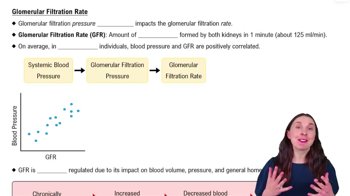
Glomerular filtration is the process where blood plasma is filtered through the glomerulus into the renal tubule. Small molecules like glucose typically pass through the glomerular membrane, while larger molecules and cells do not. This filtration is the first step in urine formation.
Recommended video:
3:15
Glomerular Filtration Rate

Tubular Reabsorption

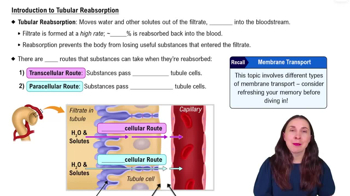
Tubular reabsorption is the process by which substances like glucose, water, and ions are reabsorbed from the filtrate back into the bloodstream by the renal tubule cells. Glucose is normally completely reabsorbed in the proximal tubule, preventing its loss in urine.
Recommended video:
4:06
Introduction to Tubular Reabsorption

Colloid Osmotic Pressure

Colloid osmotic pressure is the force exerted by plasma proteins that helps retain water in the blood vessels. While it influences fluid movement, it does not directly prevent glucose from passing into the filtrate or being lost in urine.
Recommended video:
Guided course
6:12
Partial Pressure