

Pearson+ LogoPearson+ Logo
Ch. 11 - Where Did We Come From?
Belk, Maier - Biology: Science for Life 6th Edition
Belk, Maier6th EditionBiology: Science for LifeISBN: 9780135214084Not the one you use?Change textbook
Chapter 11, Problem 9

A species of crayfish that lives in caves produces eyestalks like its above-ground relatives, but has no eyes. Eyestalks in cave-dwelling crayfish are thus ________.
a. An evolutionary error
b. A dominant mutation
c. Biogeographical evidence of evolution
d. A vestigial trait
e. Evidence that evolutionary theory may be incorrect

Verified step by step guidance
1
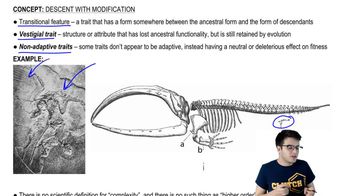
Understand the concept of vestigial traits: Vestigial traits are structures or features that were functional in an organism's ancestors but have lost their original function due to evolutionary changes. These traits persist in the organism even though they no longer serve their original purpose.
Analyze the scenario: The cave-dwelling crayfish produces eyestalks like its above-ground relatives, but it does not have functional eyes. This suggests that the eyestalks are remnants of a structure that was functional in its ancestors but no longer serves its original purpose in the cave environment.
Eliminate incorrect options: a) 'An evolutionary error' is incorrect because evolution is not a process of errors but adaptations to environments. b) 'A dominant mutation' is incorrect because the eyestalks are not described as resulting from a mutation. c) 'Biogeographical evidence of evolution' is incorrect because this term refers to the geographic distribution of species, not specific traits. e) 'Evidence that evolutionary theory may be incorrect' is incorrect because vestigial traits are consistent with evolutionary theory.
Focus on the correct option: d) 'A vestigial trait' is the most accurate answer because the eyestalks are remnants of a structure that was functional in the crayfish's ancestors but has lost its function in the cave-dwelling species.
Conclude: The presence of eyestalks in cave-dwelling crayfish is an example of a vestigial trait, which supports the concept of evolution by showing how traits can persist even after losing their original function.

Verified video answer for a similar problem:

This video solution was recommended by our tutors as helpful for the problem above.
Video duration:
45s
Was this helpful?

Key Concepts

Here are the essential concepts you must grasp in order to answer the question correctly.

Vestigial Traits

Vestigial traits are anatomical structures or behaviors that have lost most or all of their original function through the course of evolution. In the case of cave-dwelling crayfish, the eyestalks may serve little to no purpose in the absence of eyes, indicating that they are remnants of a functional trait in their ancestors.
Recommended video:
Guided course
05:58
Vestigial Traits and Evolutionary Misconceptions

Evolutionary Adaptation

Evolutionary adaptation refers to the process by which a species becomes better suited to its environment through natural selection. The presence of eyestalks in cave-dwelling crayfish, despite lacking eyes, suggests that these structures may have once been advantageous for their ancestors, but have since become less relevant in the dark cave environment.
Recommended video:
05:24
Adaptive Radiation

Natural Selection

Natural selection is a mechanism of evolution where organisms better adapted to their environment tend to survive and reproduce more than those less adapted. In the context of the crayfish, the eyestalks may not provide a survival advantage in caves, leading to their persistence as vestigial structures rather than being selected against.
Recommended video:
04:43
Natural Selection