Pearson+ LogoPearson+ Logo
Ch. 11 - Where Did We Come From?
Belk, Maier - Biology: Science for Life 6th Edition
Belk, Maier6th EditionBiology: Science for LifeISBN: 9780135214084Not the one you use?Change textbook
Chapter 11, Problem 6

The DNA sequence for the same gene found in several species of mammals_________.
a. Is identical among all species.
b. Is equally different between all pairs of mammal species.
c. Is more similar between closely related species than between distantly related species.
d. Provides evidence for the hypothesis of common descent
e. More than one of the above is correct.

Verified step by step guidance
1
Understand the concept of DNA sequence similarity: DNA sequences in genes are inherited and can accumulate mutations over time. Closely related species share a more recent common ancestor, so their DNA sequences are more similar compared to distantly related species.
Analyze the options: Option (a) states that the DNA sequence is identical among all species. This is incorrect because mutations and evolutionary divergence cause differences in DNA sequences over time.
Evaluate option (b): This option suggests that DNA differences are equal between all pairs of mammal species. This is also incorrect because evolutionary relationships determine the degree of similarity, with closer relatives having more similar sequences.
Consider option (c): This option states that DNA sequences are more similar between closely related species than between distantly related species. This is correct because closely related species share a more recent common ancestor, leading to fewer accumulated mutations.
Assess option (d) and (e): Option (d) is also correct because the similarity in DNA sequences across species supports the hypothesis of common descent. Therefore, the correct answer is (e), as more than one of the options (c and d) is correct.

Verified video answer for a similar problem:

This video solution was recommended by our tutors as helpful for the problem above.
Video duration:
49s
Was this helpful?

Key Concepts

Here are the essential concepts you must grasp in order to answer the question correctly.

DNA Sequence Conservation

DNA sequences can be conserved across different species, particularly for essential genes. This conservation often reflects the evolutionary relationships among species, where closely related species tend to have more similar DNA sequences due to shared ancestry.
Recommended video:
Guided course
02:13
Introduction to DNA Sequencing

Phylogenetics

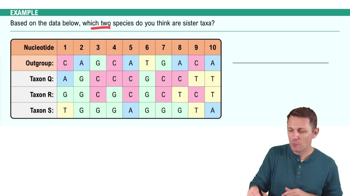
Phylogenetics is the study of evolutionary relationships among biological entities, often using DNA sequences to construct evolutionary trees. It helps in understanding how species are related and can indicate that closely related species will have more similar genetic sequences compared to those that are distantly related.
Recommended video:
04:13
Building Phylogenetic Trees Example 2

Common Descent

The hypothesis of common descent posits that all living organisms share a common ancestor. Evidence for this can be found in the similarities of DNA sequences across different species, supporting the idea that species diverged from a shared lineage over time.
Recommended video:
Guided course
04:52
Descent With Modification
Related Practice
Textbook Question

In science, a theory is a(n)

a. Educated guess

b. Inference based on a lack of scientific evidence

c. Idea with little experimental support

d. Body of scientifically acceptable general principles

e. Statement of fact

2510
views
Textbook Question

Add labels to the figure that follows, which illustrates how Mycobacterium tuberculosis evolves when it is exposed to an antibiotic.

934
views
Textbook Question

The theory of common descent states that all modern organisms

a. Can change in response to environmental change

b. Descended from a single common ancestor

c. Descended from one of many ancestors that originally arose on Earth

d. Have not evolved

e. Can be arranged in a hierarchy from 'least evolved' to 'most evolved'

2884
views
Textbook Question

Marsupial mammals give birth to young that complete their development in a pouch on the mother's abdomen. All the native mammals of Australia are marsupials, while these types of mammals are absent or uncommon on other continents. This observation is an example of

a. Developmental evidence for evolution

b. Biogeographic evidence for evolution

c. Genetic evidence for evolution

d. Fossil evidence for evolution

e. Not useful evidence for evolution

2379
views
Textbook Question

Even though marsupial mammals give birth to live young, an eggshell forms briefly early in their development. This is evidence that:

a. Marsupials share a common ancestor with some egg-laying species

b. Marsupials are not really mammals

c. All animals arose from a common ancestor.

d. Marsupial mammals were separately created by God

e. The fossil record of marsupial mammals is incorrect

1157
views
Textbook Question

A species of crayfish that lives in caves produces eyestalks like its above-ground relatives, but has no eyes. Eyestalks in cave-dwelling crayfish are thus ________.

a. An evolutionary error

b. A dominant mutation

c. Biogeographical evidence of evolution

d. A vestigial trait

e. Evidence that evolutionary theory may be incorrect

1212
views