Pearson+ LogoPearson+ Logo
Ch. 12 - An Evolving Enemy
Belk, Maier - Biology: Science for Life 6th Edition
Belk, Maier6th EditionBiology: Science for LifeISBN: 9780135214084Not the one you use?Change textbook
Chapter 12, Problem 6

An adaptation is a trait of an organism that increases:
a. Its fitness
b. Its ability to survive and replicate
c. In frequency in a population over many generations
d. A and B are correct
e. A, B, and C are correct

Verified step by step guidance
1
Step 1: Begin by understanding the term 'adaptation.' In biology, an adaptation is a characteristic or trait that enhances an organism's ability to survive and reproduce in its specific environment.
Step 2: Analyze option (a): 'its fitness.' Fitness in biology refers to an organism's ability to survive and reproduce, passing on its genes to the next generation. Adaptations directly contribute to an organism's fitness.
Step 3: Analyze option (b): 'its ability to survive and replicate.' Survival and replication (reproduction) are key components of fitness. Adaptations often improve these abilities, making this option relevant.
Step 4: Analyze option (c): 'in frequency in a population over many generations.' Adaptations that enhance fitness tend to increase in frequency within a population over time due to natural selection.
Step 5: Evaluate options (d) and (e): Option (d) states that both (a) and (b) are correct, while option (e) includes (a), (b), and (c). Since all three statements are true and interconnected, the correct answer is option (e).

Verified video answer for a similar problem:

This video solution was recommended by our tutors as helpful for the problem above.
Video duration:
2m
Was this helpful?

Key Concepts

Here are the essential concepts you must grasp in order to answer the question correctly.

Adaptation

Adaptation refers to a trait or characteristic that enhances an organism's ability to survive and reproduce in its environment. These traits can be structural, behavioral, or physiological, and they arise through the process of natural selection, where advantageous traits become more common in a population over generations.
Recommended video:
05:24
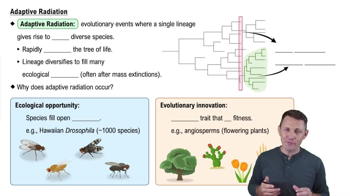
Adaptive Radiation

Fitness

In biological terms, fitness describes an organism's ability to survive and reproduce in a given environment. It is often measured by the number of offspring an organism produces that survive to reproductive age. Higher fitness indicates a greater likelihood of passing on genes to the next generation.
Recommended video:
Guided course
02:57
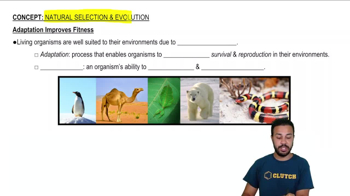
Adaptation Improves Fitness

Natural Selection

Natural selection is the process through which certain traits become more or less common in a population based on their impact on survival and reproduction. Organisms with traits that confer advantages in their environment are more likely to survive and reproduce, leading to an increase in the frequency of those traits over time.
Recommended video:
04:43
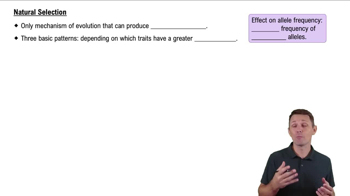
Natural Selection
Related Practice
Textbook Question

What types of drugs have helped reduce the death rate due to tuberculosis infection, and why have they become less effective more recently?

1120
views
Textbook Question

Which of the following observations is not part of the theory of natural selection?

a. Populations of organisms have more offspring than will survive

b. There is variation among individuals in a population

c. Modern organisms are unrelated

d. Traits can be passed on from parent to offspring

e. Some variants in a population have a higher probability of survival and reproduction than other variants do

3420
views
Textbook Question

The best definition of evolutionary fitness is:

a. Physical health

b. The ability to attract members of the opposite sex

c. The ability to adapt to the environment

d. Survival and reproduction relative to other members of the population

e. Overall strength

2245
views
Textbook Question

The heritable differences among organisms are a result of:

a. Differences in their DNA

b. Mutation

c. Differences in alleles

d. A and B are correct

e. A, B, and C are correct

1259
views
Textbook Question

Since the modern synthesis, the technical definition of evolution is a change in allele frequency in a population over the course of generations.

a. Traits, species

b. Allele frequency, population

c. Natural selection, natural environment

d. Adaptations, single organism

e. Fitness, population

2303
views
Textbook Question

Ivory from elephant tusks is a valuable commodity on the world market. As a result, male African elephants with large tusks have been heavily hunted for the past few centuries. Today, male elephants have significantly shorter tusks at full adulthood than male elephants in the early 1900s. This is an example of:

a. Diversifying selection

b. Stabilizing selection

c. Directional selection

d. Chance

e. More than one of the above is correct

1240
views