Pearson+ LogoPearson+ Logo
Ch. 14 - The Greatest Species on Earth?
Belk, Maier - Biology: Science for Life 6th Edition
Belk, Maier6th EditionBiology: Science for LifeISBN: 9780135214084Not the one you use?Change textbook
Chapter 14, Problem 6

On examining cells under a microscope, you notice that they occur singly and have no evidence of a nucleus. These cells must belong to a
a. Domain Eukarya
b. Domain Bacteria
c. Domain Archaea
d. The Protista
e. More than one of the above could be correct

Verified step by step guidance
1
Step 1: Begin by identifying the key characteristics of the cells described in the problem. The cells are observed to occur singly and lack a nucleus. This is a defining feature of prokaryotic cells, which are found in the domains Bacteria and Archaea.
Step 2: Recall that eukaryotic cells, which belong to the domain Eukarya, always have a nucleus and other membrane-bound organelles. Since the cells lack a nucleus, they cannot belong to the domain Eukarya or the Protista (a group within Eukarya).
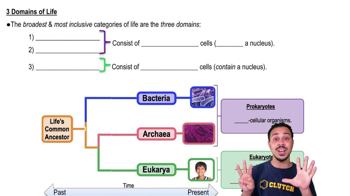
Step 3: Understand the distinction between the domains Bacteria and Archaea. Both domains consist of prokaryotic organisms, but they differ in their genetic makeup, cell membrane composition, and environmental adaptations. The problem does not provide specific details to distinguish between these two domains.
Step 4: Evaluate the option 'more than one of the above could be correct.' Since the cells could belong to either domain Bacteria or domain Archaea based on the given information, this option is plausible.
Step 5: Conclude that the correct answer must account for the lack of a nucleus and the possibility of the cells belonging to either domain Bacteria or domain Archaea. This aligns with the option 'more than one of the above could be correct.'

Verified video answer for a similar problem:

This video solution was recommended by our tutors as helpful for the problem above.
Video duration:
1m
Was this helpful?

Key Concepts

Here are the essential concepts you must grasp in order to answer the question correctly.

Prokaryotic vs. Eukaryotic Cells

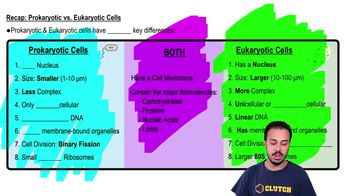
Cells are classified into two main categories: prokaryotic and eukaryotic. Prokaryotic cells, which include bacteria and archaea, lack a nucleus and membrane-bound organelles, while eukaryotic cells, found in organisms like plants and animals, have a defined nucleus. The absence of a nucleus in the observed cells indicates they are prokaryotic.
Recommended video:
Guided course
04:26
Recap: Prokaryotic vs. Eukaryotic Cells

Domain Bacteria

Bacteria are a major group of prokaryotic organisms characterized by their simple cell structure and diverse metabolic pathways. They can be found in various environments and play crucial roles in ecosystems, such as decomposing organic matter and participating in nutrient cycling. The observation of single cells without a nucleus strongly suggests that the cells belong to this domain.
Recommended video:
Guided course
05:20
3 Domains of Life

Domain Archaea

Archaea are another group of prokaryotic organisms that are distinct from bacteria, often found in extreme environments like hot springs and salt lakes. They share some similarities with eukaryotes, such as certain genetic and biochemical traits, but like bacteria, they do not have a nucleus. The cells observed could also potentially belong to this domain, depending on their specific characteristics.
Recommended video:
Guided course
05:20
3 Domains of Life