Pearson+ LogoPearson+ Logo
Ch. 16 - Conserving Biodiversity
Belk, Maier - Biology: Science for Life 6th Edition
Belk, Maier6th EditionBiology: Science for LifeISBN: 9780135214084Not the one you use?Change textbook
Chapter 16, Problem 11

There are fewer lions in Africa's Serengeti than there are zebras. This is principally because
a. Zebras tend to drive off lions
b. Lions compete directly with cheetahs, whereas zebras do not have any competitors
c. Zebras have mutualists that increase their population, whereas lions do not
d. There is less energy available in zebras to support the lion population than there is in grass to support the zebras
e. Zebras are a keystone species, whereas lions are not

Verified step by step guidance
1
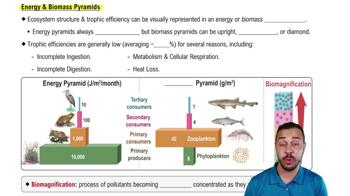
Step 1: Understand the concept of energy transfer in ecosystems. Energy flows through trophic levels, starting from primary producers (like grass) to primary consumers (like zebras) and then to secondary consumers (like lions). At each level, energy is lost due to metabolic processes, making less energy available for higher trophic levels.
Step 2: Analyze the relationship between lions and zebras. Lions are predators that rely on zebras as a food source. Zebras, on the other hand, consume grass, which is abundant and serves as a primary energy source.
Step 3: Consider the principle of energy availability. Since energy diminishes as it moves up trophic levels, there is less energy available to support the lion population compared to the energy available to support the zebra population.
Step 4: Evaluate the other answer choices. For example, zebras do not drive off lions (a), lions and cheetahs do not compete directly for zebras (b), and zebras are not considered mutualists with other species that increase their population (c). Additionally, zebras are not classified as keystone species (e).
Step 5: Conclude that the correct answer is related to energy availability. The principle reason for fewer lions than zebras is that there is less energy available in zebras to support the lion population than there is in grass to support the zebras.

Verified video answer for a similar problem:

This video solution was recommended by our tutors as helpful for the problem above.
Video duration:
1m
Was this helpful?

Key Concepts

Here are the essential concepts you must grasp in order to answer the question correctly.

Trophic Levels and Energy Transfer

In an ecosystem, energy flows from producers to various levels of consumers. Lions, as apex predators, occupy a higher trophic level than zebras, which are herbivores. The energy available to support a population decreases at each trophic level due to energy loss through metabolic processes. This concept explains why fewer lions can be supported compared to zebras, as there is less energy available to sustain higher-level consumers.
Recommended video:
Guided course
05:41
Energy & Biomass Pyramids

Keystone Species

A keystone species is one that has a disproportionately large impact on its environment relative to its abundance. Zebras can be considered a keystone species because their grazing habits help maintain the grassland ecosystem, promoting biodiversity. In contrast, while lions are important for controlling prey populations, they do not have the same level of ecological influence as zebras, which can affect the structure of the entire ecosystem.
Recommended video:
03:24
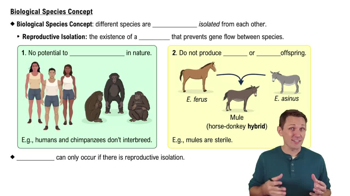
Biological Species Concept

Competition and Mutualism

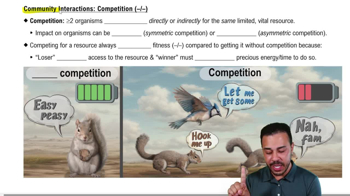
Competition occurs when species vie for the same resources, which can limit population sizes. In this context, lions compete with other predators like cheetahs for food, while zebras may benefit from mutualistic relationships with other species, such as birds that eat parasites off their bodies. These interactions can enhance zebra populations, while lions face more direct competition, contributing to their lower numbers in comparison.
Recommended video:
Guided course
02:13
Community Interactions: Competition (-/-)