Pearson+ LogoPearson+ Logo
Ch. 9 - Biology of Wrongful Convictions
Belk, Maier - Biology: Science for Life 6th Edition
Belk, Maier6th EditionBiology: Science for LifeISBN: 9780135214084Not the one you use?Change textbook
Chapter 9, Problem 9

Add labels to the figure that follows, which illustrates the components in the PCR reaction. Illustration of PCR steps showing DNA strands and primers in a biotechnology context.

Verified step by step guidance
1
Identify the DNA template strand in the image, which is the red strand with the sequence CAGTACTT and GTCATGAA.
Label the primers, which are the short grey sequences that bind to the template strand. The primers in the image are GTC and CTT.
Label the DNA polymerase enzyme, which is represented by the green structures that facilitate the addition of nucleotides to the growing DNA strand.
Label the newly synthesized DNA strands, which are shown as the pink sequences being extended from the primers.
Label the direction of DNA synthesis, which is indicated by the arrows showing the 5' to 3' direction of the new strand synthesis.

Verified video answer for a similar problem:

This video solution was recommended by our tutors as helpful for the problem above.
Video duration:
1m
Was this helpful?

Key Concepts

Here are the essential concepts you must grasp in order to answer the question correctly.

Polymerase Chain Reaction (PCR)

PCR is a molecular biology technique used to amplify specific DNA sequences. It involves repeated cycles of denaturation, annealing, and extension, allowing for the exponential increase of the target DNA. This method is essential for various applications, including cloning, gene expression analysis, and genetic testing.
Recommended video:
Guided course
01:31
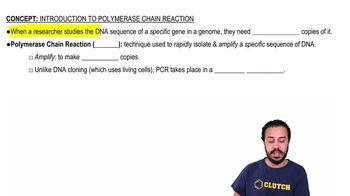
Introduction to Polymerase Chain Reaction

Primers

Primers are short, single-stranded sequences of nucleotides that provide a starting point for DNA synthesis during PCR. They are designed to be complementary to the target DNA sequences, ensuring specificity in amplification. The correct design and concentration of primers are crucial for the success of the PCR process.
Recommended video:
Guided course
05:03
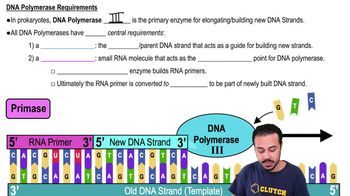
DNA Polymerase Requirements

DNA Polymerase

DNA polymerase is an enzyme that synthesizes new DNA strands by adding nucleotides complementary to the template strand during PCR. It plays a vital role in the extension phase of the reaction, where it catalyzes the formation of phosphodiester bonds between nucleotides. The choice of DNA polymerase can affect the efficiency and fidelity of the PCR.
Recommended video:
Guided course
04:01
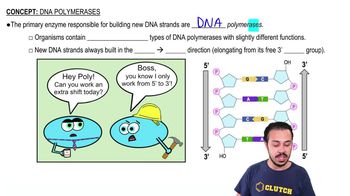
DNA Polymerases