Pearson+ LogoPearson+ Logo
Ch. 9 - Biology of Wrongful Convictions
Belk, Maier - Biology: Science for Life 6th Edition
Belk, Maier6th EditionBiology: Science for LifeISBN: 9780135214084Not the one you use?Change textbook
Chapter 9, Problem 8

Which of the following is not part of the procedure used to make a DNA profile?
a. Short tandem repeat sequences are amplified by PCR.
b. DNA is placed in a gel and subjected to an electric current.
c. The genes that encode DNA sequence are cloned into bacteria.
d. DNA from blood, semen, vaginal fluids, or hair root cells can be used for analysis.

Verified step by step guidance
1
Step 1: Understand the concept of DNA profiling. DNA profiling is a technique used to identify individuals based on their unique DNA sequences. It involves analyzing specific regions of DNA, such as short tandem repeats (STRs), which vary greatly among individuals.
Step 2: Review the procedure of DNA profiling. Key steps include: (a) extracting DNA from a sample (e.g., blood, semen, vaginal fluids, or hair root cells), (b) amplifying specific DNA regions using polymerase chain reaction (PCR), and (c) separating DNA fragments using gel electrophoresis by applying an electric current.
Step 3: Analyze the options provided in the question. Compare each option to the standard steps of DNA profiling. For example, amplifying STR sequences by PCR and using gel electrophoresis are standard procedures, while cloning genes into bacteria is not part of DNA profiling.
Step 4: Identify the option that does not align with the DNA profiling process. Cloning genes into bacteria is a technique used in genetic engineering, not DNA profiling, which focuses on analyzing existing DNA sequences rather than cloning them.
Step 5: Conclude that the correct answer is the option describing cloning genes into bacteria, as it is unrelated to the procedure of DNA profiling.

Verified video answer for a similar problem:

This video solution was recommended by our tutors as helpful for the problem above.
Video duration:
2m
Was this helpful?

Key Concepts

Here are the essential concepts you must grasp in order to answer the question correctly.

DNA Profiling

DNA profiling, also known as DNA fingerprinting, is a technique used to identify individuals based on their unique DNA characteristics. It typically involves analyzing specific regions of DNA, such as short tandem repeats (STRs), which vary greatly among individuals. This method is widely used in forensic science, paternity testing, and genetic research.
Recommended video:
Guided course
04:01
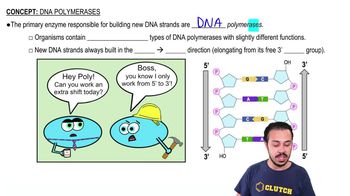
DNA Polymerases

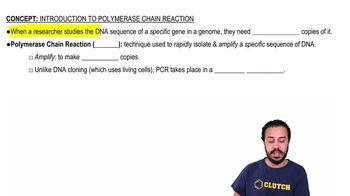
Polymerase Chain Reaction (PCR)

Polymerase Chain Reaction (PCR) is a molecular biology technique used to amplify specific DNA sequences, making millions of copies of a particular segment. This process is crucial in DNA profiling as it allows for the analysis of small samples of DNA, such as those obtained from crime scenes. PCR involves repeated cycles of denaturation, annealing, and extension to achieve amplification.
Recommended video:
Guided course
01:31
Introduction to Polymerase Chain Reaction

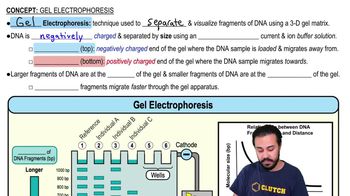
Gel Electrophoresis

Gel electrophoresis is a laboratory method used to separate DNA fragments based on their size and charge. In this technique, DNA samples are placed in a gel matrix and subjected to an electric current, causing the fragments to migrate through the gel. Smaller fragments move faster and farther than larger ones, allowing for the visualization and comparison of DNA profiles.
Recommended video:
Guided course
07:58
Gel Electrophoresis