Pearson+ LogoPearson+ Logo
Ch. 9 - Biology of Wrongful Convictions
Belk, Maier - Biology: Science for Life 6th Edition
Belk, Maier6th EditionBiology: Science for LifeISBN: 9780135214084Not the one you use?Change textbook
Chapter 9, Problem 7

Epigenetic changes involving methylation can directly affect the phenotype of an individual or her offspring by ________.
a. Causing correlations between parents and children
b. Causing changes to the DNA that affect gene expression but not DNA sequence
c. Generating low heritability
d. Increasing the likelihood of monozygotic twinning
e. Sterilizing the DNA

Verified step by step guidance
1
Understand the concept of epigenetics: Epigenetics refers to changes in gene expression that do not involve alterations to the DNA sequence itself. These changes can be influenced by environmental factors and can affect how genes are turned on or off.
Focus on methylation: Methylation is a common epigenetic mechanism where methyl groups are added to DNA, typically at cytosine bases in CpG islands. This process can suppress gene expression by preventing transcription factors from binding to the DNA.
Analyze the options: Review each answer choice to determine which one aligns with the definition and effects of methylation. For example, methylation does not alter the DNA sequence itself, so options involving changes to the sequence can be ruled out.
Consider the impact on phenotype: Methylation can directly affect the phenotype by regulating gene expression. This regulation can influence traits and characteristics without changing the underlying DNA sequence.
Select the correct answer: Based on the understanding of methylation and its role in epigenetics, identify the option that best describes how methylation affects gene expression and phenotype without altering the DNA sequence.

Verified video answer for a similar problem:

This video solution was recommended by our tutors as helpful for the problem above.
Video duration:
3m
Was this helpful?

Key Concepts

Here are the essential concepts you must grasp in order to answer the question correctly.

Epigenetics

Epigenetics refers to the study of heritable changes in gene expression that do not involve alterations to the underlying DNA sequence. These changes can be influenced by various factors, including environmental conditions, lifestyle, and developmental stages. Epigenetic modifications, such as DNA methylation and histone modification, play a crucial role in regulating gene activity and can affect an organism's phenotype.

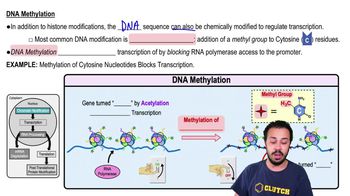
DNA Methylation

DNA methylation is a specific epigenetic mechanism where a methyl group is added to the DNA molecule, typically at cytosine bases. This modification can inhibit gene expression by preventing the binding of transcription factors or recruiting proteins that compact the DNA, making it less accessible for transcription. Methylation patterns can be stable and heritable, influencing traits in both the individual and their offspring.
Recommended video:
Guided course
03:39
DNA Methylation

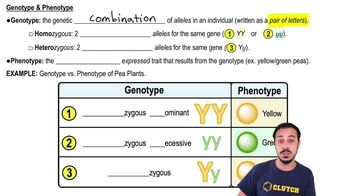
Phenotype

Phenotype refers to the observable physical and physiological traits of an organism, which result from the interaction of its genotype with the environment. This includes characteristics such as morphology, development, biochemical properties, and behavior. Epigenetic changes, like those caused by DNA methylation, can lead to variations in phenotype without altering the genetic code, demonstrating the dynamic relationship between genes and environment.
Recommended video:
Guided course
06:36
Genotype & Phenotype
Related Practice
Textbook Question

A quantitative trait ________.

a. May be one that is strongly influenced by the environment

b. Varies continuously in a population

c. May be influenced by many genes

d. Is not either off or on

e. All of the above

1449
views
Textbook Question

When graphing the phenotypes of a trait controlled by many genes and the environment, the line showing the frequency of each phenotype resembles ________.

a. A horizontal, straight line

b. A vertical, straight line

c. The letter T

d. A bell shape

e. A circle

1450
views
Textbook Question

When a trait is highly heritable, ________.

a. It is influenced by genes

b. It is not influenced by the environment

c. The variance of the trait in a population can be explained primarily by variance in genotypes

d. A and C are correct

e. A, B, and C are correct

1252
views
Textbook Question

Which of the following is not part of the procedure used to make a DNA profile?

a. Short tandem repeat sequences are amplified by PCR.

b. DNA is placed in a gel and subjected to an electric current.

c. The genes that encode DNA sequence are cloned into bacteria.

d. DNA from blood, semen, vaginal fluids, or hair root cells can be used for analysis.

1091
views
Textbook Question
Add labels to the figure that follows, which illustrates the components in the PCR reaction.

853
views
Textbook Question

Which of the following statements is consistent with the DNA profile shown below?

a. B is the child of A and C

b. C is the child of A and B

c. D is the child of B and C

d. A is the child of B and C

e. A is the child of C and D

1030
views