
Pearson+ LogoPearson+ Logo
Ch. 9 - Biology of Wrongful Convictions
Belk, Maier - Biology: Science for Life 6th Edition
Belk, Maier6th EditionBiology: Science for LifeISBN: 9780135214084Not the one you use?Change textbook
Chapter 9, Problem 10

Which of the following statements is consistent with the DNA profile shown below?
DNA profile comparison for individuals A, B, C, and D in a gel electrophoresis format.
a. B is the child of A and C
b. C is the child of A and B
c. D is the child of B and C
d. A is the child of B and C
e. A is the child of C and D

Verified step by step guidance
1
Step 1: Understand the concept of DNA profiling. DNA profiling involves comparing DNA band patterns to determine genetic relationships. A child inherits half of their DNA from each parent, so their DNA bands will match bands from both parents.
Step 2: Analyze the DNA bands for individual A. Note the positions of the bands in A's profile and compare them to the profiles of B, C, and D.
Step 3: Compare the DNA bands of B and C to A. Check if A's bands can be explained as a combination of bands from B and C, which would indicate that A is their child.
Step 4: Analyze the DNA bands for individual D. Compare D's bands to B and C to determine if D's bands are a combination of bands from B and C, which would indicate that D is their child.
Step 5: Evaluate all options (a, b, c, d, e) based on the comparisons made. Determine which statement is consistent with the DNA profiles shown, ensuring the child’s bands match a combination of the parents’ bands.

Verified video answer for a similar problem:

This video solution was recommended by our tutors as helpful for the problem above.
Video duration:
2m
Was this helpful?

Key Concepts

Here are the essential concepts you must grasp in order to answer the question correctly.

DNA Profiling

DNA profiling, also known as DNA fingerprinting, is a technique used to identify individuals based on their unique DNA characteristics. It involves analyzing specific regions of DNA that vary greatly among individuals, allowing for comparison between samples. This method is commonly used in forensic science, paternity testing, and genetic research.
Recommended video:
Guided course
04:01
DNA Polymerases

Gel Electrophoresis

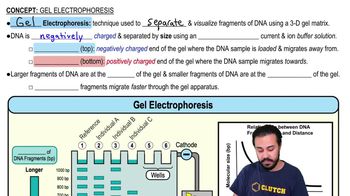
Gel electrophoresis is a laboratory method used to separate DNA fragments based on their size. In this technique, DNA samples are placed in a gel matrix and subjected to an electric field, causing the fragments to migrate at different rates. Smaller fragments move faster than larger ones, resulting in a distinct banding pattern that can be visualized and compared across samples.
Recommended video:
Guided course
07:58
Gel Electrophoresis

Inheritance Patterns

Inheritance patterns refer to the ways in which genetic traits are passed from parents to offspring. Understanding these patterns is crucial for interpreting DNA profiles, as they can indicate familial relationships. For example, a child inherits half of their DNA from each parent, which can be analyzed to determine potential parent-child relationships based on matching DNA bands in a gel electrophoresis result.
Recommended video:
Guided course
01:02
Autosomal Inheritance