Pearson+ LogoPearson+ Logo
Ch. 2 - The Chemical Context of Life
Campbell - Campbell Biology 11th Edition
Urry11th EditionCampbell BiologyISBN: 9789357423311Not the one you use?Change textbook
Chapter 2, Problem 1

In the term trace element, the adjective trace means that
a. The element is required in very small amounts.
b. The element can be used as a label to trace atoms through an organism's metabolism.
c. The element is very rare on Earth.
d. The element enhances health but is not essential for the organism's long-term survival.

Verified step by step guidance
1
Understand the definition of 'trace element' in biology: Trace elements are minerals present in living tissues in small amounts and are essential for various physiological functions.
Consider the context of the term 'trace' in biology: It typically refers to the quantity required by organisms, which is usually very small.
Evaluate option a: This option suggests that trace elements are required in very small amounts, which aligns with the biological definition of trace elements.
Examine option b: This option implies that trace elements are used as labels in metabolic processes, which is not the primary definition of trace elements.
Review options c and d: Option c suggests rarity on Earth, and option d suggests non-essentiality for survival, neither of which accurately describe trace elements in biological terms.

Verified video answer for a similar problem:

This video solution was recommended by our tutors as helpful for the problem above.
Video duration:
4m
Was this helpful?

Key Concepts

Here are the essential concepts you must grasp in order to answer the question correctly.

Trace Elements

Trace elements are minerals required by living organisms in minute quantities for proper physiological functioning. Despite their small required amounts, they play crucial roles in various biological processes, such as enzyme function and hormone production. Examples include iron, zinc, and iodine.
Recommended video:
Guided course
03:36
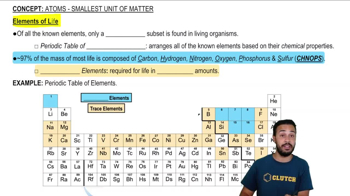
Elements of Life

Metabolism

Metabolism refers to the set of life-sustaining chemical reactions within organisms. These processes allow organisms to grow, reproduce, maintain their structures, and respond to environmental changes. Metabolism is divided into catabolism, which breaks down molecules to release energy, and anabolism, which builds up molecules using energy.
Recommended video:
Guided course
07:08
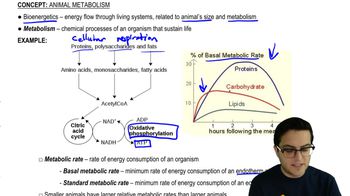
Metabolic Rate

Essential Nutrients

Essential nutrients are compounds that organisms cannot synthesize in sufficient quantities and must obtain from their diet. These include vitamins, minerals, amino acids, and fatty acids. Essential nutrients are vital for maintaining health, supporting growth, and preventing diseases, making them indispensable for survival.
Recommended video:
Guided course
03:25
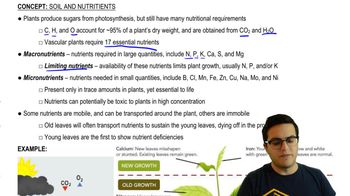
Soil Nutrients