Pearson+ LogoPearson+ Logo
Ch. 38 - Angiosperm Reproduction and Biotechnology
Campbell - Campbell Biology 11th Edition
Urry11th EditionCampbell BiologyISBN: 9789357423311Not the one you use?Change textbook
Chapter 38, Problem 1

A fruit is:
a. A mature ovary
b. A mature ovule
c. A seed plus its integuments
d. An enlarged embryo sac

Verified step by step guidance
1
Begin by understanding the basic structure of a flower. A flower typically consists of male and female reproductive parts. The female part, known as the pistil, includes the ovary, which contains ovules.
Recognize that after fertilization, the ovary undergoes changes to become a fruit. This process involves the maturation of the ovary, which is a key concept in identifying what a fruit is.
Consider the role of the ovule. The ovule, once fertilized, develops into a seed. However, the fruit itself is not the ovule; it is the structure that encases the seed.
Differentiate between the terms 'ovary' and 'ovule'. The ovary is the part of the flower that develops into the fruit, while the ovule becomes the seed within the fruit.
Conclude that a fruit is a mature ovary, as it is the part of the plant that develops to protect and aid in the dispersal of seeds.

Verified video answer for a similar problem:

This video solution was recommended by our tutors as helpful for the problem above.
Video duration:
1m
Was this helpful?

Key Concepts

Here are the essential concepts you must grasp in order to answer the question correctly.

Fruit Development

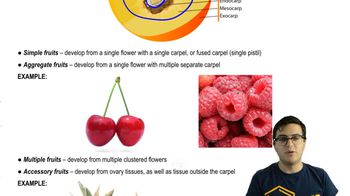
A fruit is the mature ovary of a flower, typically containing seeds. It develops after fertilization when the ovary wall thickens and forms the pericarp, which can be fleshy or dry. This process is crucial for seed protection and dispersal, ensuring the continuation of plant species.
Recommended video:

Ovary and Ovule

In flowering plants, the ovary is the part of the pistil that contains the ovules. The ovule is the structure that develops into a seed after fertilization. The ovary matures into a fruit, while the ovule becomes the seed, highlighting the distinction between these two components in plant reproduction.
Recommended video:
Guided course
02:59
Ovaries and Testes

Seed Structure

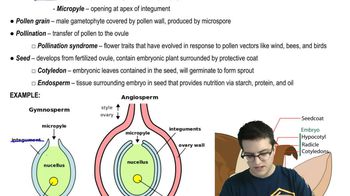
A seed is composed of an embryo, a supply of nutrients, and a protective outer covering called the seed coat. The seed coat, derived from the integuments of the ovule, safeguards the embryo and aids in its dispersal. Understanding seed structure is essential for comprehending how plants reproduce and spread.
Recommended video:
Guided course
06:26
Seed Plants - 1