
Pearson+ LogoPearson+ Logo
Ch. 45 - Hormones and the Endocrine System
Campbell - Campbell Biology 11th Edition
Urry11th EditionCampbell BiologyISBN: 9789357423311Not the one you use?Change textbook
Chapter 45, Problem 6

Which of the following is the most likely explanation for hypothyroidism in a patient whose iodine level is normal?
a. Greater production of T3 than of T4
b. Hyposecretion of TSH
c. Hypersecretion of MSH
d. A decrease in the thyroid secretion of calcitonin

Verified step by step guidance
1
Understand that hypothyroidism is a condition where the thyroid gland does not produce enough thyroid hormones, primarily T3 (triiodothyronine) and T4 (thyroxine).
Recognize that iodine is essential for the production of T3 and T4. Since the iodine level is normal, the issue is not due to iodine deficiency.
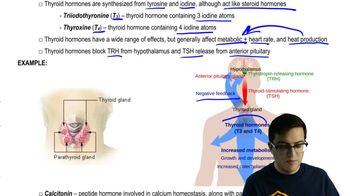
Consider the role of TSH (Thyroid Stimulating Hormone), which is produced by the pituitary gland and stimulates the thyroid to produce T3 and T4. Hyposecretion of TSH would lead to reduced stimulation of the thyroid gland, resulting in lower production of thyroid hormones.
Evaluate the other options: Greater production of T3 than T4 is not typically associated with hypothyroidism, hypersecretion of MSH (Melanocyte Stimulating Hormone) is unrelated to thyroid function, and calcitonin is involved in calcium regulation, not directly in thyroid hormone production.
Conclude that the most likely explanation for hypothyroidism in this scenario, given normal iodine levels, is hyposecretion of TSH, as it directly affects the thyroid's ability to produce sufficient hormones.

Verified video answer for a similar problem:

This video solution was recommended by our tutors as helpful for the problem above.
Video duration:
1m
Was this helpful?

Key Concepts

Here are the essential concepts you must grasp in order to answer the question correctly.

Hypothyroidism

Hypothyroidism is a condition where the thyroid gland does not produce enough thyroid hormones, leading to symptoms like fatigue, weight gain, and depression. It can be caused by various factors, including autoimmune diseases, certain medications, or issues with the pituitary gland. Understanding the underlying cause is crucial for effective treatment.

Thyroid-Stimulating Hormone (TSH)

TSH is a hormone produced by the pituitary gland that stimulates the thyroid gland to produce thyroid hormones, T3 and T4. In cases of hypothyroidism, TSH levels are typically elevated as the body attempts to stimulate more hormone production. However, if TSH is low or normal, it may indicate a problem with the pituitary gland itself, leading to hyposecretion of TSH.
Recommended video:
Guided course
04:39
Thyroid and Parathyroid Glands

Iodine and Thyroid Function

Iodine is an essential element for the production of thyroid hormones. A deficiency in iodine can lead to hypothyroidism, but if iodine levels are normal, other causes must be considered. This includes issues with hormone production or regulation, such as pituitary gland dysfunction, which affects TSH secretion and subsequently thyroid hormone levels.
Recommended video:
Guided course
04:39
Thyroid and Parathyroid Glands
Related Practice
Textbook Question

Growth factors are local regulators that

a. Are produced by the anterior pituitary.

b. Are modified fatty acids that stimulate bone and cartilage growth.

c. Are found on the surface of cancer cells and stimulate abnormal cell division.

d. Bind to cell-surface receptors and stimulate growth and development of target cells.

1366
views
Textbook Question

Which hormone is incorrectly paired with its action?

a. Oxytocin — stimulates uterine contractions during childbirth

b. Thyroxine — inhibits metabolic processes

c. ACTH — stimulates the release of glucocorticoids by the adrenal cortex

d. Melatonin — affects biological rhythms and seasonal reproduction

2215
views
Textbook Question

What do steroid and peptide hormones typically have in common?

a. Their solubility in cell membranes

b. Their requirement for travel through the bloodstream

c. The location of their receptors

d. Their reliance on signal transduction in the cell

2530
views
1
rank
Textbook Question

The relationship between the insect hormones ecdysteroid and PTTH is an example of

a. An interaction of the endocrine and nervous systems.

b. Homeostasis achieved by positive feedback.

c. Homeostasis maintained by antagonistic hormones.

d. Competitive inhibition of a hormone receptor.

1080
views
Textbook Question

In mammals, milk production by mammary glands is controlled by prolactin and prolactin-releasing hormone. Draw a simple sketch of this pathway, including glands, tissues, hormones, routes for hormone movement, and effects.

2447
views