Pearson+ LogoPearson+ Logo
Ch. 47 - Animal Development
Campbell - Campbell Biology 11th Edition
Urry11th EditionCampbell BiologyISBN: 9789357423311Not the one you use?Change textbook
Chapter 47, Problem 5

If an egg cell were treated with EDTA, a chemical that binds calcium and magnesium ions,
a. The acrosomal reaction would be blocked.
b. The fusion of sperm and egg nuclei would be blocked.
c. The fast block to polyspermy would not occur.
d. The fertilization envelope would not form.

Verified step by step guidance
1
Understand the role of calcium and magnesium ions in fertilization. These ions are crucial for various processes during fertilization, including the acrosomal reaction, fusion of sperm and egg nuclei, and formation of the fertilization envelope.
Consider the acrosomal reaction, which is the release of enzymes from the sperm's acrosome that allows it to penetrate the egg. Calcium ions are essential for this process, so binding them with EDTA could block the acrosomal reaction.
Examine the fusion of sperm and egg nuclei. This process requires calcium ions for the activation of the egg and subsequent fusion. If EDTA binds these ions, the fusion might be inhibited.
Explore the fast block to polyspermy, which prevents multiple sperm from fertilizing the egg. This involves changes in the egg's membrane potential, often mediated by calcium ions. EDTA binding could prevent this fast block from occurring.
Analyze the formation of the fertilization envelope, a process that involves the release of cortical granules and is dependent on calcium ions. If EDTA binds these ions, the fertilization envelope might not form.

Verified video answer for a similar problem:

This video solution was recommended by our tutors as helpful for the problem above.
Video duration:
1m
Was this helpful?

Key Concepts

Here are the essential concepts you must grasp in order to answer the question correctly.

Acrosomal Reaction

The acrosomal reaction is a crucial step in fertilization where enzymes are released from the sperm's acrosome to penetrate the egg's outer layers. This process requires calcium ions, which facilitate the fusion of the sperm with the egg's plasma membrane. Without calcium, the acrosomal reaction cannot proceed, preventing sperm from entering the egg.
Recommended video:
Guided course
01:56
Chemical Reactions

Fast Block to Polyspermy

The fast block to polyspermy is a rapid response that prevents multiple sperm from fertilizing an egg. It involves a change in the egg's membrane potential, triggered by the influx of sodium ions, which is dependent on calcium ions. This electrical change prevents additional sperm from fusing with the egg after the first successful fertilization.
Recommended video:
Guided course
03:35
Carbon is an Excellent Building Block

Fertilization Envelope Formation

The fertilization envelope is a protective layer that forms around the egg after fertilization to prevent polyspermy. This process is initiated by the release of calcium ions, which trigger the cortical reaction, leading to the hardening of the vitelline layer into a fertilization envelope. Without calcium, this protective barrier cannot form, leaving the egg vulnerable to multiple sperm entries.
Recommended video:
Guided course
01:59
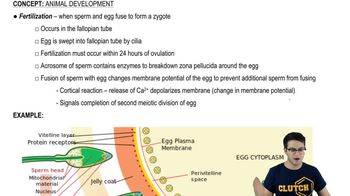
Fertilization