Pearson+ LogoPearson+ Logo
Ch. 55 - Ecosystems and Restoration Ecology
Campbell - Campbell Biology 11th Edition
Urry11th EditionCampbell BiologyISBN: 9789357423311Not the one you use?Change textbook
Chapter 55, Problem 1

Which of the following organisms is incorrectly paired with its trophic level?
a. Cyanobacterium—primary producer
b. Grasshopper—primary consumer
c. Zooplankton—primary producer
d. Fungus—detritivore

Verified step by step guidance
1
Understand the concept of trophic levels: Trophic levels represent the position an organism occupies in a food chain, which is a sequence of organisms each dependent on the next as a source of food.
Identify the role of a primary producer: Primary producers are organisms that produce biomass from inorganic compounds. In most ecosystems, these are photosynthetic organisms like plants and algae.
Identify the role of a primary consumer: Primary consumers are herbivores that feed on primary producers. They are the second trophic level in a food chain.
Identify the role of a detritivore: Detritivores are organisms that feed on dead organic material, breaking it down into simpler substances. They play a crucial role in decomposition and nutrient cycling.
Evaluate each organism's trophic level: Compare the given organisms with their described trophic levels. Cyanobacterium is a primary producer, grasshopper is a primary consumer, zooplankton is typically a primary consumer, and fungus is a detritivore. Identify the mismatch in the pairings.

Verified video answer for a similar problem:

This video solution was recommended by our tutors as helpful for the problem above.
Video duration:
2m
Was this helpful?

Key Concepts

Here are the essential concepts you must grasp in order to answer the question correctly.

Trophic Levels

Trophic levels refer to the hierarchical positions in a food chain, representing the flow of energy and nutrients. Primary producers, like plants and cyanobacteria, convert solar energy into chemical energy through photosynthesis. Primary consumers, such as grasshoppers, feed on primary producers, while detritivores, like fungi, decompose organic matter, recycling nutrients back into the ecosystem.
Recommended video:
Guided course
03:14
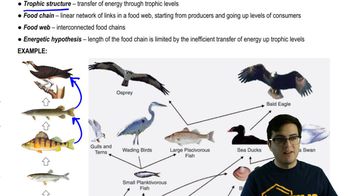
Trophic Structure

Primary Producers

Primary producers are organisms that produce biomass from inorganic compounds, primarily through photosynthesis. They form the base of the food chain, providing energy for all other trophic levels. Cyanobacteria are a type of primary producer, using sunlight to create energy-rich compounds, supporting various aquatic and terrestrial ecosystems.
Recommended video:
Guided course
04:36
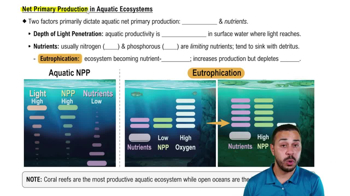
Primary Production in Aquatic Ecosystems

Detritivores

Detritivores are organisms that feed on dead organic matter, breaking it down into simpler substances. This process is crucial for nutrient cycling, as it returns essential elements to the soil and water, supporting primary producers. Fungi are common detritivores, decomposing complex organic materials and contributing to ecosystem sustainability.
Recommended video: