Ch. 5 - Integration
Briggs - Calculus: Early Transcendentals 3rd Edition
Briggs3rd EditionCalculus: Early TranscendentalsISBN: 9780136847243Not the one you use?Change textbook
Chapter 5, Problem 5.R.23b

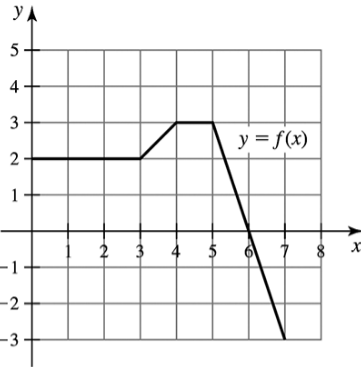
Area by geometry Use geometry to evaluate the following definite integrals, where the graph of ƒ is given in the figure.
(b) ∫₆⁴ ƒ(𝓍) d𝓍
Graph of a function showing a piecewise linear shape, with labeled axes and a defined area under the curve.

Verified step by step guidance
1
Step 1: Observe the graph of the function ƒ(x) between x = 4 and x = 6. The graph consists of two geometric shapes: a triangle and a rectangle. To evaluate the definite integral ∫₆⁴ ƒ(x) dx, calculate the areas of these shapes.
Step 2: Identify the triangle in the interval [4, 5]. The base of the triangle is 1 unit (from x = 4 to x = 5), and the height is 1 unit (from y = 2 to y = 3). Use the formula for the area of a triangle: A = (1/2) × base × height.
Step 3: Identify the rectangle in the interval [5, 6]. The width of the rectangle is 1 unit (from x = 5 to x = 6), and the height is 2 units (from y = 0 to y = 2). Use the formula for the area of a rectangle: A = width × height.
Step 4: Add the areas of the triangle and rectangle together. Since the integral represents the net area under the curve, ensure that all areas above the x-axis are positive.
Step 5: Combine the calculated areas to find the total area under the curve between x = 4 and x = 6. This total represents the value of the definite integral ∫₆⁴ ƒ(x) dx.

Verified video answer for a similar problem:

This video solution was recommended by our tutors as helpful for the problem above.
Video duration:
2m
Was this helpful?

Key Concepts

Here are the essential concepts you must grasp in order to answer the question correctly.

Definite Integral

A definite integral represents the signed area under a curve between two points on the x-axis. It is calculated using the Fundamental Theorem of Calculus, which connects differentiation and integration. In this context, evaluating the definite integral ∫₆⁴ ƒ(𝓍) d𝓍 involves finding the area under the graph of the function f(x) from x = 4 to x = 6.
Recommended video:
05:43
Definition of the Definite Integral

Area Under a Curve

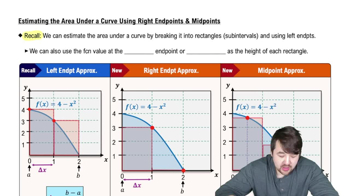
The area under a curve can be interpreted geometrically as the total area between the curve and the x-axis over a specified interval. For piecewise linear functions, this area can be calculated by breaking it into simpler geometric shapes, such as rectangles and triangles, and summing their areas. This approach is particularly useful when the function is defined in segments, as seen in the provided graph.
Recommended video:
05:59
Estimating the Area Under a Curve with Right Endpoints & Midpoint

Piecewise Function

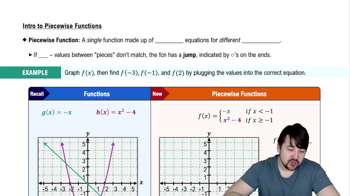
A piecewise function is defined by different expressions or formulas over different intervals of its domain. In the given graph, the function f(x) consists of linear segments that change at specific x-values. Understanding how to interpret and calculate areas for piecewise functions is essential for evaluating integrals, as each segment may contribute differently to the total area.
Recommended video:
05:36
Piecewise Functions
Related Practice
Textbook Question

Evaluating integrals Evaluate the following integrals.


∫₋₂² (3𝓍⁴―2𝓍 + 1) d𝓍

59
views

Textbook Question

Explain why or why not Determine whether the following statements are true and give an explanation or counterexample. Assume ƒ and ƒ' are continuous functions for all real numbers.

(c) ∫ₐᵇ ƒ'(𝓍) d𝓍 = ƒ(b) ―ƒ(a) .

51
views
Textbook Question

Area by geometry Use geometry to evaluate the following definite integrals, where the graph of ƒ is given in the figure.

(a) ∫₀⁴ ƒ(𝓍) d𝓍

96
views
Textbook Question

Evaluating integrals Evaluate the following integrals.


∫₀¹ 𝓍 • 2ˣ²⁺¹ d𝓍

88
views
Textbook Question

Evaluating integrals Evaluate the following integrals.                                                                                                                                         


 ∫ (9𝓍⁸―7𝓍⁶) d𝓍

55
views
Textbook Question

Area functions and the Fundamental Theorem Consider the function

ƒ(t) = { t      if  ―2 ≤ t < 0

t²/2    if    0 ≤ t ≤ 2

and its graph shown below. Let F(𝓍) = ∫₋₁ˣ ƒ(t) dt and G(𝓍) = ∫₋₂ˣ ƒ(t) dt.

(e) Evaluate F ''(―1) and F ''(1). Interpret these values.

61
views