Ch. 8 - Integration Techniques
Briggs - Calculus: Early Transcendentals 3rd Edition
Briggs3rd EditionCalculus: Early TranscendentalsISBN: 9780136847243Not the one you use?Change textbook
Chapter 8, Problem 8.6.19

7–84. Evaluate the following integrals.
19. ∫ from 0 to π/2 [sin⁷x] dx

Verified step by step guidance
1
Recognize that the integral involves a power of sine, specifically sin⁷(x). To simplify, use the reduction formula for powers of sine: ∫sinⁿ(x) dx = (1/n)∫sinⁿ⁻¹(x)cos(x) dx.
Since the integral is definite, with limits from 0 to π/2, consider using a substitution to simplify the integral. Let u = cos(x), which implies du = -sin(x) dx.
Transform the integral using the substitution u = cos(x). The limits of integration change accordingly: when x = 0, u = cos(0) = 1; when x = π/2, u = cos(π/2) = 0.
Rewrite the integral in terms of u: ∫sin⁷(x) dx becomes ∫(-u⁷) du, with the limits of integration now from 1 to 0. The negative sign can be factored out to reverse the limits.
Evaluate the integral ∫u⁷ du using the power rule for integration: ∫uⁿ du = (uⁿ⁺¹)/(n+1). Apply the new limits of integration (from 1 to 0) to find the result.

Verified video answer for a similar problem:

This video solution was recommended by our tutors as helpful for the problem above.
Video duration:
6m
Was this helpful?

Key Concepts

Here are the essential concepts you must grasp in order to answer the question correctly.

Definite Integral

A definite integral calculates the accumulation of a function's values over a specific interval, represented as ∫ from a to b f(x) dx. It provides the net area under the curve of the function f(x) between the limits a and b. In this case, the integral from 0 to π/2 of sin⁷x requires evaluating the area under the curve of sin⁷x within that interval.
Recommended video:
05:43
Definition of the Definite Integral

Trigonometric Functions

Trigonometric functions, such as sine and cosine, relate angles to ratios of sides in right triangles. The function sin(x) oscillates between -1 and 1, and its powers, like sin⁷x, affect the shape of the graph. Understanding the behavior of sin(x) is crucial for evaluating integrals involving trigonometric functions, especially when raised to a power.
Recommended video:
6:04
Introduction to Trigonometric Functions

Integration Techniques

Integration techniques are methods used to evaluate integrals that may not be solvable by basic antiderivatives. Common techniques include substitution, integration by parts, and trigonometric identities. For the integral of sin⁷x, using the identity sin²x = 1 - cos²x can simplify the expression, making it easier to integrate over the specified limits.
Recommended video:
06:18
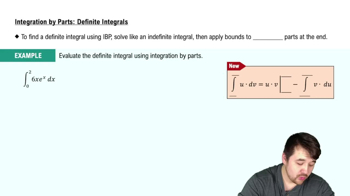
Integration by Parts for Definite Integrals