Ch. 8 - Integration Techniques
Briggs - Calculus: Early Transcendentals 3rd Edition
Briggs3rd EditionCalculus: Early TranscendentalsISBN: 9780136847243Not the one you use?Change textbook
Chapter 8, Problem 8.5.73

73. Two methods Evaluate ∫ dx/(x² - 1), for x > 1, in two ways: using partial fractions and a trigonometric substitution. Reconcile your two answers.

Verified step by step guidance
1
First, recognize that the integral is \( \int \frac{dx}{x^2 - 1} \) with \( x > 1 \). Notice that the denominator factors as \( x^2 - 1 = (x - 1)(x + 1) \). This suggests using partial fractions to decompose the integrand.
Set up the partial fraction decomposition: \( \frac{1}{x^2 - 1} = \frac{A}{x - 1} + \frac{B}{x + 1} \). Multiply both sides by \( (x - 1)(x + 1) \) to get \( 1 = A(x + 1) + B(x - 1) \). Solve for constants \( A \) and \( B \) by choosing convenient values for \( x \) or by equating coefficients.
Once \( A \) and \( B \) are found, rewrite the integral as \( \int \left( \frac{A}{x - 1} + \frac{B}{x + 1} \right) dx \). Integrate each term separately to get logarithmic expressions involving \( x - 1 \) and \( x + 1 \).
For the trigonometric substitution method, note that \( x^2 - 1 \) resembles \( \sec^2 \theta - 1 = \tan^2 \theta \). Use the substitution \( x = \sec \theta \), which implies \( dx = \sec \theta \tan \theta \, d\theta \). Rewrite the integral in terms of \( \theta \) and simplify.
After substitution, the integral becomes \( \int \frac{\sec \theta \tan \theta \, d\theta}{\sec^2 \theta - 1} = \int \frac{\sec \theta \tan \theta}{\tan^2 \theta} d\theta = \int \frac{\sec \theta}{\tan \theta} d\theta \). Simplify and integrate with respect to \( \theta \), then back-substitute \( \theta = \sec^{-1} x \) to express the answer in terms of \( x \). Finally, compare this result with the one from partial fractions to reconcile the two expressions.

Verified video answer for a similar problem:

This video solution was recommended by our tutors as helpful for the problem above.
Video duration:
5m
Was this helpful?

Key Concepts

Here are the essential concepts you must grasp in order to answer the question correctly.

Partial Fraction Decomposition

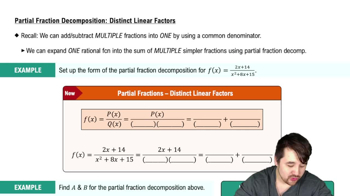
Partial fraction decomposition breaks a rational function into simpler fractions that are easier to integrate. For ∫ dx/(x² - 1), factor the denominator as (x - 1)(x + 1) and express the integrand as A/(x - 1) + B/(x + 1). Solving for A and B allows straightforward integration using logarithmic functions.
Recommended video:
10:07
Partial Fraction Decomposition: Distinct Linear Factors

Trigonometric Substitution

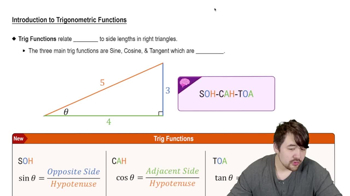
Trigonometric substitution replaces algebraic expressions with trigonometric functions to simplify integrals involving quadratic expressions. For x² - 1, substituting x = sec(θ) transforms the integral into one involving trigonometric identities, making it easier to integrate and then revert back to x.
Recommended video:
6:04
Introduction to Trigonometric Functions

Reconciliation of Different Integral Forms

Different integration methods can yield expressions that look different but represent the same function up to constants. Reconciling involves using algebraic identities and inverse trigonometric or logarithmic relationships to show equivalence, ensuring both methods produce consistent antiderivatives.
Recommended video:
Guided course
3:56
Slope-Intercept Form